8 Cruises That Let You Spend More Time in Port
8 Cruises That Let You Spend More Time in Port

Conrad Schutt/Courtesy of MSC Cruises
https://www.fodors.com/news/photos/want-time-to-explore-a-destination-book-these-cruises-that-stay-longer-at-ports
These cruises won’t rush you from one port to the next.
Cruising gets a bad rap. Locals have long complained that cruise passengers descend into cities and towns for a few hours and leave without exploring culture or spending tourist dollars. They aren’t wrong. It is expensive for cruises to dock for longer periods, especially at popular destinations, and a stationary cruise also burns a lot of fuel. Thus, port calls only last a few hours. But with the advent of slow travel, cruises have started to change their approach, and now many cruises give passengers more time to discover a destination. If time at a port is a deciding factor for you, then you’ll be happy with these options that don’t rush you to make it back after a quick meal or excursion.

PHOTO: VIRGIN VOYAGES
1 OF 8
Virgin Voyages
Adults-only cruise company Virgin Voyages has designed itineraries with longer stays and overnighters. In Europe, there are more than 15 itineraries with longer stays. The 10-day cruise from Greece stops in Santorini and Dubrovnik until late, and passengers also get to spend the night in Mykonos. A Northern European voyage stays overnight in Amsterdam, while a 12-night Alaska cruise offers more time at each port.

PHOTO: COURTESY OF NORWEGIAN CRUISE LINE
2 OF 8
Norwegian Cruise Line
With extensive routes, Norwegian Cruise Line gives globetrotters options for weekend getaways as well as transatlantic voyages. Their 11-day Australia cruise stays overnight in Adelaide and Melbourne, and takes cruisers to Kangaroo Island and Tasmania. All year round, the company also offers a 7-day Hawaii voyage with overnights in Maui and Kaua`i. A Caribbean cruise that embarks on an 11-night journey from Philadelphia stays two nights in Bermuda and is a favorite among Redditers.

PHOTO: CELEBRITY CRUISES
3 OF 8
Celebrity Cruises
Part of the Royal Caribbean Group, Celebrity Cruises is known for its upscale atmosphere and great dining. You’ll also find many itineraries with multiple days at port, including stops in Bermuda. A 14-night Asia voyage docks overnight in Bali, Port Klang and Penang in Malaysia, and Phuket in Thailand. Longer Hawaiian cruises also spend extra time at ports, and European voyages also offer this opportunity to guests. The smaller ship with 172 passengers will cruise the Danube next year with overnight stops in Budapest, Bratislava, Vienna, and Vilshofen.

PHOTO: ART MEDIA FACTORY/SHUTTERSTOCK
4 OF 8
Azamara Cruises
Azamara is a boutique cruise line with smaller ships that accommodate fewer than 700 guests. What sets it apart is that it offers stays longer than 10 hours at port and includes overnight stops, and you are likely to find an itinerary that gives you more time at destinations. In the Mediterranean, it has a 14-night combination cruise that overnights in Nice, Florence, the Amalfi Coast, and Athens. Another interesting itinerary is the China and Taiwan cruise, which takes you to Beijing, Shanghai, Naha, Taipei, and Hong Kong in 15 nights with four overnight stays in port. There are also itineraries with overnight stays in Bermuda. Look up their Country Intensive and Combination Cruises for more options.

PHOTO: CONRAD SCHUTT/COURTESY OF MSC CRUISES
5 OF 8
MSC Cruises
The Swiss cruise liner specializes in the Mediterranean with its year-long itineraries. But apart from Europe, you can discover the Caribbean with the Italian-influenced cruiser. MSC has a private island, Ocean Cay, in Ocean Bay, Bahamas, and it brings cruisers there for multiple days. A 10-day itinerary from Miami and back offers two days on the private island.

PHOTO: OCEANIA CRUISES
6 OF 8
Oceania Cruises
Oceania Cruises operates midsize ships and offers a premium experience, and a part of that is giving guests more time at ports. It offers destination-rich voyages with overnight stays, and you’ll quite like how they have crafted their cruises. More than 90 journeys have overnight voyages in their 2026-2027 Tropics and Exotics season. The Sydney to Sydney voyage anchors for a night in Sydney and Cairns; the London to Oslo voyage lets you explore Alesund in Norway and Copenhagen in Denmark. And if you want to explore South America and Antarctica at a slower pace, the 54-day Valparaiso to Miami is an incredible option.

PHOTO: COURTESY OF SILVERSEA
7 OF 8
Silversea Cruises
The ultra-luxury Silversea features intimate cruise ships with suites and personalized service. Many of its offerings have overnight ports of call, and you’ll enjoy the time spent onboard as well as offshore. Check out the Grand Voyages tours for a peek into what it entails: there’s a 59-day Mediterranean tour, a 51-day cruise around Asia, and a 77-day exploration of South America. Each itinerary has a stopover in destinations you want to uncover, such as Rome, Malaga, Phuket, Kobe, Manaus, and Buenos Aires.

PHOTO: RSSC
8 OF 8
Regent Seven Seas
All-inclusive, luxury cruise line Regent Seven Seas has launched an Immersive Overnights collection, where cruisers can spend multiple days at each port. A Stockholm to Oslo journey gives sailors two days each in Stockholm, Copenhagen, and Oslo, while extending it to three days in Berlin. A 10-day Lisbon to Lisbon voyage stays two nights in each port of call: Lisbon, Santander, Bordeaux, and Bilbao. Want to go bigger? There’s a 150-night world cruise on the recently refurbished Seven Seas Mariner with 13 overnight stays across 70 ports of call in 31 countries.
Related: Regent Seven Seas Mariner
‘Airport Malaria’ Kills 2 in Europe, Sickens 4 More

Rapha Wilde/Unsplash
https://www.fodors.com/news/photos/airport-malaria-kills-2-in-europe-sickens-4-more
And more of today's top travel news stories.
Today in travel, we have several stories that may have flown under your radar. Among them: Airport malaria kills two in Germany; Bali pushes back against CDC Zika advice; airports in the U.K. announce a data breach; and an Italian man has been sentenced to prison after concocting a fake tourist attraction.
Dive into these and more as we examine the latest in travel news.
Some or all of this article was crafted with help from AI. An editor reviewed and vetted this article before publishing.

PHOTO: RADOSLAV BALI/UNSPLASH
1 OF 5
Bali Pushes Back on CDC Zika Warning
Earlier this month, the U.S. Centers for Disease Control and Prevention issued a Level 2 Travel Health Notice for Zika in Indonesia after infections were reported among travelers returning from Bali. The CDC is advising anyone visiting the island to take extra precautions against mosquito bites and the sexual transmission of the virus both during and after a trip.
The guidance is stronger for people who are pregnant or planning a pregnancy. The CDC specifically recommends that pregnant travelers avoid Bali; if a trip cannot be postponed, they should strictly follow Zika prevention measures. People planning a pregnancy are advised to wait after returning from Bali according to the CDC’s recommended timeframes, since Zika infection during pregnancy can cause birth defects.
Bali officials, meanwhile, say no Zika infections have been detected or reported locally to date. The island’s health and tourism authorities are encouraging visitors to protect themselves from mosquito bites in much the same way they would against dengue. For most travelers, a Level 2 notice calls for enhanced precautions rather than avoiding the destination altogether—but the CDC’s separate recommendation that pregnant travelers avoid Bali is important.

PHOTO: PHILIP LANGE/SHUTTERSTOCK
2 OF 5
Two Dead in Rare “Airport Malaria” Cluster at Frankfurt Airport
Six people whose work is connected to Frankfurt Airport have developed malaria tropica since early July 2026, according to the Frankfurt Health Office. Two have died, while the other four have been discharged from the hospital. Five of the patients became ill in early July, with a sixth case emerging in mid-August.
Health officials say the cases are consistent with the extremely rare phenomenon known as “airport malaria.” It can occur when an infected Anopheles mosquito is carried by air from a region where malaria is endemic and subsequently bites someone at or near an airport. Authorities say the cluster does not represent an increased risk to the general public. Malaria also does not spread between people through ordinary day-to-day contact.
The health office is monitoring mosquitoes at the airport and conducting genetic testing of the malaria parasites to determine whether the cases are connected. Health authorities across Hesse and neighboring states have also been asked to alert doctors to consider malaria in airport workers with unexplained fever or symptoms such as chills, headaches, body aches, or gastrointestinal problems—even when the patient has not recently traveled to a malaria-endemic country. Officials emphasize that malaria tropica can be fully treated when it is identified early and treatment begins promptly.

PHOTO: SAKHANPHOTOGRAPHY/SHUTTERSTOCK
3 OF 5
Manchester Airports Group Says Customer Data Was Accessed in Cybersecurity Incident
Manchester Airports Group (MAG) says an unauthorized third party obtained customer data in a cybersecurity incident affecting information associated with Manchester, London Stansted, and East Midlands airports. The data relates to airport parking, lounge and Fast Track bookings, as well as registrations for airport Wi-Fi. Airport operations and aviation security have not been affected.
MAG says the information accessed includes email addresses, phone numbers, vehicle registration numbers, and postal codes. The company says neither MAG nor the affected system holds customers’ bank or payment information. Existing bookings remain valid and passengers can continue traveling as normal.
As a precaution, MAG has temporarily disabled its online Manage My Booking service. Customers who urgently need to change a booking taking place within the next 72 hours are being directed to Customer Services. MAG says it has contacted affected customers directly and is urging people to watch for suspicious emails, texts, or phone calls. The airport group says it will not unexpectedly contact customers asking for payment-card information, banking details, or passwords.

PHOTO: COURTESY OF MSC WORLD EUROPA
4 OF 5
MSC Cruise Lifeguard Arrested in Miami Over Alleged Sexual Activity With 17-Year-Old Passenger
A lifeguard working aboard the MSC World America was arrested at PortMiami on August 22 after authorities accused him of unlawful sexual activity with a 17-year-old passenger. Rafael Cayetano Blanco, a 38-year-old Guatemalan national, was taken into custody by the Miami-Dade Sheriff’s Office when the ship returned to Miami.
According to the arrest report, Blanco met the passenger aboard the ship on August 16 and the two exchanged phone numbers. Investigators allege that the passenger later went to his cabin and that sexual activity occurred there on August 16 and again on August 19. The arrest report says Blanco subsequently admitted to the encounters while being questioned. Jail records showed that he remained in custody on an immigration hold following his arrest.
MSC Cruises says it dismissed the crew member after learning of the alleged conduct and contacted law enforcement. The company also said it cooperated with investigators and provided assistance to the passenger.

5 OF 5
Italian Man Jailed Over Fake “Ancient” Theater He Built for Tourists
An Italian man is serving a 28-month prison sentence after constructing a fake archaeological site on a hillside outside Vicenza and presenting it to paying visitors as an ancient theater. Franco Malosso created the roughly 54,000-square-foot Anfiteatro Berico near Arcugnano using modern materials including newly quarried stone, cement columns, and plaster statues, with some elements deliberately altered to make them appear old.
Malosso promoted the site as an archaeological discovery containing ancient Greek and Roman remains. Prosecutors said he claimed it had been uncovered after a landslide and told visitors stories linking the site to Julius Caesar and Cleopatra. Local authorities investigated in 2016 and quickly determined that the supposed ruins were modern construction rather than an ancient site.
According to CNN, visitors from outside the area were charged 12 euros, while locals were charged 40 euros; private group tours were reportedly offered for 600 euros. Malosso was convicted in 2019 of offenses including unauthorized construction and counterfeiting works of art. Italy’s highest court later rejected his final appeal, and he is now serving the resulting 28-month sentence along with a 3,000-euro fine.
The property has been under seizure since the investigation, and Malosso was ordered to remove the unauthorized construction and restore the hillside. That work has not been completed, however, and recent Italian reporting indicates that the ultimate fate of the sprawling fake ruins remains unresolved.
The decision dividend: How AI creates economic value

https://www.mckinsey.com/industries/industrials/our-insights/the-decision-dividend-how-ai-creates-economic-value?
By
AI’s largest gains rarely come from labor savings alone. They come from faster decisions, better use of existing assets, and opportunities that would otherwise be missed.
Most companies know exactly what they spend on labor, raw materials, and capital equipment. Few, however, can quantify how much they spend making decisions—even though decisions determine nearly every aspect of business performance, from pricing and production to capital allocation and customer service.
The omission is understandable because decision-making is embedded in daily activities, rather than captured as a separate activity. Managers, engineers, analysts, and frontline employees spend countless hours gathering information, evaluating alternatives, coordinating with colleagues, and obtaining approvals. As organizations grow, meetings, review cycles, and governance requirements multiply, making decision-making one of the largest—but least visible—operating costs. Although companies invest heavily in developing decision-making frameworks for everything from procurement to pricing, the resulting improvements often fall short of the effort required.
For decades, organizations had little choice but to absorb such costs because high-quality decisions depended almost entirely on human judgment, analysis, and coordination. But many companies are now increasingly relying on AI tools to optimize and accelerate “decisioning”—the process of setting strategies and selecting the next-best action—across business functions. Early pilots have shown promising results, including lower operational costs, accelerated product launches, and higher customer satisfaction. Few companies have managed to replicate these benefits at scale, however, raising questions about AI’s true economic value.
Much debate also continues about how AI confers value, with research often focusing on productivity and cost cutting, including the often-controversial strategy of replacing human workers with machines. This cost-focused perspective may overemphasize the potential for labor reduction while overlooking the value that AI generates by helping companies make better and faster decisions, from making better use of existing assets to capturing opportunities they would otherwise miss.
AI should be understood not simply as a labor-saving technology but also as one that enables cheaper and better decisions. As more decisions flow through AI, companies will benefit from better resource allocation, faster execution, and more consistent outcomes. For that reason, decision throughput can serve as a leading indicator of its future financial performance. To understand AI’s economic impact as a decision-making tool, three questions are central: Can AI generate attractive returns on invested capital? Where does its economic value actually come from? And what metrics and management practices enable companies to capture that value at scale?
A new cost curve for intelligence
Answering the first question—whether AI can generate attractive returns on invested capital—involves a simple question: whether the returns on this technology exceed its costs. For AI, both sides of that equation differ from previous waves of technological change.
Unlike many earlier game-changing technologies, AI does not require organizations to build or own the underlying infrastructure. That creates a much lower investment burden than other innovations, such as steam power, which necessitated redesigned factories and production systems, or electrification, which required access to transmission and distribution networks, among other costly upgrades. AI follows a fundamentally different model. Hyperscalers invest hundreds of billions of dollars to build and operate data centers, then provide AI capabilities as a shared service to millions of organizations. In 2026 alone, capital expenditures by the four largest hyperscalers are expected to exceed $700 billion. As a result, companies can access frontier AI through usage-based pricing rather than making large up-front capital investments.
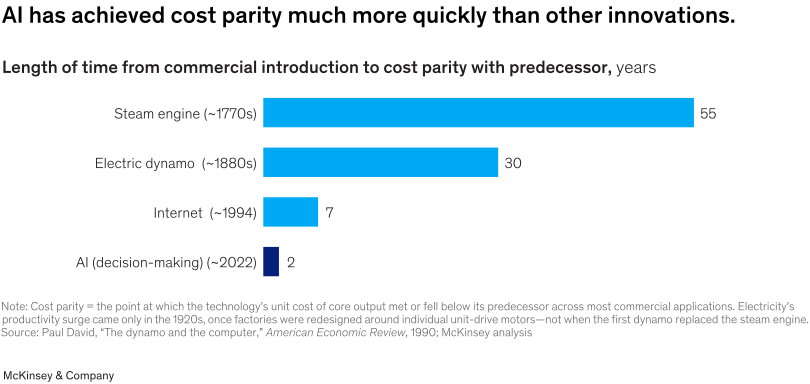
This shared infrastructure has fundamentally changed the cost of applying intelligence. According to recent research, AI can reduce the cost of decision-making by over 90 percent, with tasks that required about $40 in human labor in 2023 now estimated to cost fractions of a cent (see sidebar “Estimated AI cost reductions”). The potential to compress decision timelines is equally significant, with data suggesting that AI can shift decision-making timeliness from weeks or months to seconds. If companies can replicate these benefits at scale today—an accomplishment few have achieved—it would mean that AI has reached cost parity with human labor in about two years (Exhibit 1). No previous general-purpose technology has become economically viable for such a large number of organizations so quickly. Steam power took roughly 55 years to reach that threshold, the electric dynamo (a type of generator) about 30 years, and the internet about seven years.
Exhibit 1
We strive to provide individuals with disabilities equal access to our website. If you would like information about this content, we will be happy to work with you. Please email us at: McKinsey_Website_Accessibility@mckinsey.com
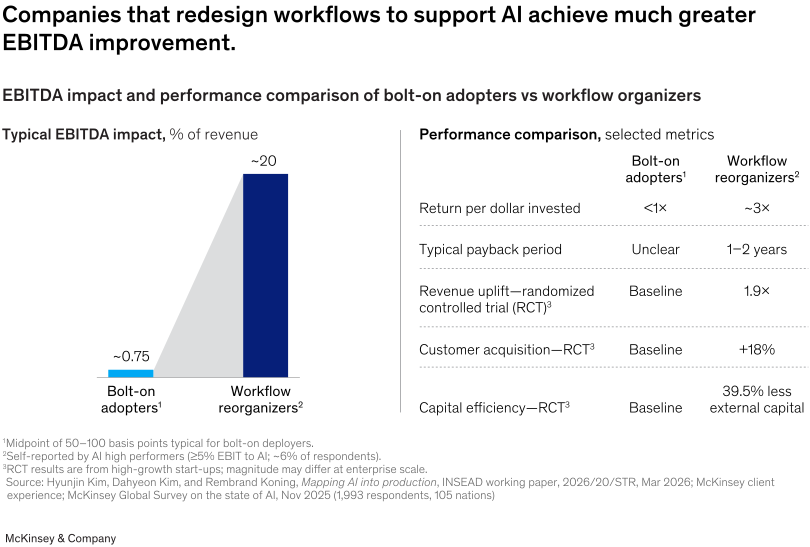
The findings on cost parity suggest that AI is no longer constrained by economics and that any company can potentially profit from AI. The question, then, is: Why do most organizations still report little or no measurable impact on earnings? The answer appears to lie in implementation strategy. Most companies are now layering copilots, chatbots, and dashboards onto their existing processes, producing only modest financial gains (Exhibit 2). By contrast, companies that redesign end-to-end workflows around AI often achieve a roughly 20 percent EBITDA uplift, three dollars of profit for every dollar invested, and payback periods of one to two years. The most proactive companies will redesign workflows before selecting tools.
Exhibit 2
We strive to provide individuals with disabilities equal access to our website. If you would like information about this content, we will be happy to work with you. Please email us at: McKinsey_Website_Accessibility@mckinsey.com
The number of companies profiting from AI may increase as more companies refine their implementation processes. The magnitude of their potential gains raises a deeper question, however: What is actually driving AI’s economic value?
The overlooked sources of AI value
Given that much AI research concentrates on cost reduction, company leaders cannot be faulted if they focus on this benefit, nor could workers be criticized for fearing they might lose their jobs to a machine. But a look at sales, general, and administrative (SG&A) expenses, which include those related to planning teams, management layers, and approval processes, suggests that the source of AI’s value is actually more complex. At most companies, even mature ones, SG&A typically runs at 5 to 12 percent. Even large reductions in these costs would not explain how AI could potentially improve EBITDA by 20 percent.
If cost reduction alone cannot account for AI’s financial impact, other sources of value must be involved. Many of these benefits are less visible because they arise not from eliminating jobs but from improving how organizations make decisions—for example, by enabling better decisions, accelerating execution, reducing coordination, and creating new opportunities for growth. Our analysis suggests that much of AI’s economic value arises from the following sources:
- Faster action. With AI, companies can compress decision cycles from weeks to days, or from days to hours, giving them a better chance of taking quick action to address problems and improve outcomes. For instance, AI may deliver rapid recommendations after analyzing information on demand signals. But AI implementation alone will not ensure speedy decisions; companies must also revise their existing planning cycles and associated workflows, both of which tend to be lengthy.
- Better use of existing assets. Many companies invest heavily in new capacity because existing assets appear to be operating near their limits. In reality, production schedules, maintenance plans, and operating parameters are often based on outdated assumptions. The result is lower throughput, unnecessary downtime, and equipment that delivers less than it could. Better decisions help companies get more from the assets they already own, increasing output and utilization without adding equipment or labor.
- Improved ability to capture opportunities. Weak growth is often attributed to market conditions or capacity constraints. In practice, organizations frequently miss opportunities because they cannot react quickly enough or remain constrained by outdated assumptions that fail to account for AI’s ability to transform timelines and economics. Product launches slip. Inventory ends up in the wrong locations. Capacity is allocated inefficiently. As decision costs fall, companies gain the ability to evaluate more opportunities, test more scenarios, and act before circumstances change.
These effects often appear in sequence. Faster decisions improve the use of existing assets. Better asset utilization creates flexibility. Greater flexibility improves an organization’s ability to capture opportunities. Over time, the gains compound. At some industrial companies using AI, the greatest value comes from these overlooked sources. Headcount has remained stable, suggesting that labor-related cost reductions are not a major factor.
For a Fortune 500 industrial company that successfully implements AI, the gains from faster action, better asset use, and capturing new opportunities could potentially reach hundreds of millions of dollars. Regulation, capital intensity, and switching costs might influence how quickly those gains emerge, but they will rarely alter the underlying economics.

The new economics of AI
A leadership guide to creating, governing, and scaling value with AI.
The conundrum of measuring AI’s potential value
Although AI’s potential is clear, as are the sources of its value, companies may still have difficulty determining if they are capturing this technology’s full potential. Looking at SG&A costs will give an incomplete picture because much of the value comes from other sources that do not appear as simple line items on a balance sheet.
Lacking clear objective financial metrics, many organizations default to other indicators to measure their success, such as the number of AI tools licensed, models deployed, or pilots launched. While these metrics measure ambition, they tell little about potential returns. What’s more, they may not give a true picture of a company’s AI activity. Even a company with multiple AI tools may not use them extensively or wisely.
To find better measures—especially during these early days when many companies have not yet seen gains—companies should look to manufacturers and other industrial businesses. Long ago, these companies learned that a factory’s performance should be judged by what it produces, not by how often its machines are running or how much new equipment has been installed. The same principle applies to AI: What matters is not how many tools there are but how many decisions are optimized. That makes decision throughput—the percent of decisions that are informed, accelerated, or automated by AI—the most important metric.
Rising throughput indicates that AI is becoming embedded in core workflows and influencing more decisions (see sidebar “Embedding AI into the organization”). Consider a manufacturer that typically adjusts its production schedules once per week. If the company increases decision throughput by evaluating demand, inventory, and equipment availability every hour, it can optimize schedules several times per day.
As with any metric, decision throughput alone does not provide a complete picture of performance or potential outcomes. Other factors, such as operating models, governance, and change management, may influence the success of AI efforts, as discussed in our companion article, “Is that AI agent worth it? Agentic economics and the modern operating model.”
How CEOs can maximize decision throughput and increase the value of AI
For CEOs and other leaders, maximizing AI decision throughput and precision is critical to capturing AI’s full economic potential. But more decisions do not automatically translate into more value. High operating costs can erase the benefits of greater throughput, while decisions that are inaccurate or low value contribute little to business outcomes. Focusing on six priorities can help CEOs improve both AI decision throughput and the value created by every decision:
- Start where decisions matter most. The greatest gains usually come from improving decisions that directly affect production, resource allocation, customer outcomes, or capital efficiency—areas where decisions are both expensive to make and economically important. A mining company may start with production optimization. A distributor may start with demand sensing. Early efforts should focus on decisions with the largest economic consequences.
- Focus on decision-making in select areas before expanding. Organizations should demonstrate measurable economic impact in one or two critical areas before extending AI decision-making to other areas. Early successes create operational experience, reusable code, and practical knowledge that reduce the cost and risk of future deployments. At Freeport-McMoRan, roughly 60 percent of the code developed at the first site was later reused in other locations, allowing each deployment to proceed faster than the last.
- Learn quickly. Every major technology wave has produced more unsuccessful experiments than successful ones. The objective is not to eliminate failure but to make experimentation inexpensive, identify high-return decision domains quickly, and redeploy resources toward the applications that create the greatest economic value.
- Define accountability. People must have confidence that proper safeguards are in place when AI manages certain decisions. Companies can increase their trust by clearly specifying when AI can act independently, when escalation to human review is required, and who is accountable for the ultimate results. Without such guidelines, some leaders may hesitate to delegate decision-making to AI, leading to lower throughput. Effective governance will also lower the organizational cost of adopting AI by enabling lower-cost decisions without increasing operational risk.
- Track economic outcomes, not activity. Licenses purchased, models deployed, and pilots launched reveal little about business performance. Metrics should focus on decision throughput, asset utilization, revenue growth, margin improvement, and other measures tied directly to economic value. CEOs will benefit from a close examination of individual AI initiatives because the same task can sometimes cost 30 times more than it does in other cases, solely because of execution factors. The overall objective is not simply to automate more decisions but to ensure the value created exceeds the cost of making them.
- Treat delay as a cost. A $50 million initiative postponed for four quarters can become a $75 million to $100 million problem—not because the technology changed, but because the organization lost a year of learning, operational improvement, and financial impact. Once CEOs have a strategy for scaling AI decision-making, they should execute it.
Beyond increasing decision throughput and ensuring that AI is applied to the most critical areas, CEOs must make broader operational changes, including those related to overall accountability, insourcing and outsourcing, performance management, scaling, and data investment.
The economics of AI are often framed as a labor story, but that does not explain the magnitude of the returns achieved by leading adopters. Those gains arise because AI enables organizations to make better decisions faster—not simply because it reduces labor costs. Better decisions improve the use of existing assets, increase organizational flexibility, and enable companies to capture opportunities that slower competitors miss. The competitive advantage will come not from having AI, but from building an organization that can consistently turn better decisions into better business outcomes.
DUHC&S | Strategic Hospitality Consulting & Advisory
We transform hospitality and tourism businesses through strategic solutions, operational efficiency, and comprehensive renovation. With over 40 years of experience working with brands like Hilton, Hyatt, Sheraton, and Sonesta, we enhance asset value and profitability through:
• Business reengineering and renovation
• Operational excellence and brand standards (GSI +90%)
• Market penetration and commercial strategies
• Key partnerships and disruptive innovation
• Hotel openings and repositioning
Proven results:
✅ 48% GOP
✅ +120% asset valuation growth
✅ Successful projects across 6 Latin American countries
👇 To read the full analysis and connect with us, please check the link in the first comment.
🔹 Let's connect with DUHC&S:
👉 https://linktr.ee/diurugeles
📩 Email: diurugeles@gmail.com
📱 WhatsApp: +57 3153259968
🌐 Access our full blog analysis, YouTube channel, LinkedIn, and social media through a single link.
#DUHC&S #HospitalityConsulting #OperationalExcellence #Hotels #BusinessTransformation ---
Disclaimer:
DUHC&S shares this information for educational and informational purposes only. The news articles reproduced here are sourced from public and recognized media outlets. We are not the original authors of this content but rather its distributors. All credit goes to the original sources cited in each article. If you are the legitimate owner of any material and wish to have it modified or removed, please contact us immediately at diurugeles@gmail.com, and we will address your request promptly.


Comments
Post a Comment