We Hate These 11 Vacation Upcharges! Do Everything You Can to Avoid Paying Them
We Hate These 11 Vacation Upcharges! Do Everything You Can to Avoid Paying Them

neirfy/iStock
https://www.fodors.com/news/photos/vacation-upcharges-to-avoid
When traveling, be prepared to dodge needless upcharges.
Upcharges can be a vacation buzzkill, turning your relaxation escape into a wallet-draining nightmare and wreaking havoc on your trip’s budget. While some may be unavoidable, like hotel parking, you may be able to sidestep others. We’re calling out these 11 unnecessary, annoying extra charges loathed by travelers everywhere.

PHOTO: JOSE CARLOS CERDENO/ISTOCK
1 OF 11
Restaurant Surcharges
On cruises and at all-inclusive resorts, meals are typically built into the price of the trip. But if you have your eye on an upgraded cut of steak, lobster tail, foie gras, or other premium menu selections, it might cost you extra. Even more egregious are restaurants tagged as “specialty dining” that aren’t part of your package, leading to FOMO if you want to experience a five-course tasting menu or sushi dinner—a policy that’s especially irritating if other options are limited. Do your research before booking to see how many (and which) restos are included, making sure you have enough variety during the length of your stay.

PHOTO: DRAGONIMAGES/ISTOCK
2 OF 11
Spa Facility Charges
There’s been an uptick lately in spa “hydrotherapy circuits,” which often amount to no more than glorified pools and hot tubs with jets and different temperatures. Call us underwhelmed. These trendy yet overhyped facilities always incur an average fee of $50 or $75—sometimes even if you book a pricey massage or facial. Besides the fact that they’re just way overpriced for the experience, they tend to get boring very quickly. And attendants instructing you to jump under a freezing cold rain shower or plunge pool or stay in the stifling sauna for an allotted amount of time might make the experience downright uncomfortable.

PHOTO: YACOBCHUK/ISTOCK
3 OF 11
In-Room Bottled Water
Hotel rooms are often stocked with water bottles adorned with tags inviting guests to enjoy the refreshment, for upwards of $7, $8, or even $10 a pop. Why must a basic need like hydration be so spendy, especially since you might be using the water to fill your coffee machine for your morning java? When it comes down to it, the tap water might be perfectly fine (and even better than bottled in places like Iceland or Switzerland). We hope more hotels follow the trend of daily glass bottles of filtered water in rooms or refillable stations on every floor—and provide a reusable bottle during your stay to cut down on single-use plastics.

PHOTO: VTT STUDIO/ISTOCK
4 OF 11
Lost Towel Card or Room Key Fines
Enough already with the towel cards. No guest should need to trade a piece of plastic for a basic pool or beach amenity, nor be made to fear a fine for not returning their scratchy, stained, worn beach towels at the end of the day. Ditto for losing your bracelet room key at an all-inclusive resort, which might have been attached too loosely at check-in and easily slipped off in the pool or when you were bodysurfing. Both of these charges are a total racket.

PHOTO: EYEEM MOBILE GMBH/ISTOCK
5 OF 11
Resort Fees
This mandatory fee can add an extra $25 or $50 to your nightly room charge. While the reservation agent or front desk attendant will rattle off all the amenities the resort fee covers, they’re often ones that you should be getting anyway, like beach chairs, use of the fitness center, wi-fi, and bike rentals. The kicker is that you pay this fee whether or not you use the perks, and most likely you won’t be allowed to opt out. Some booking sites don’t list this add-on when you’re comparing properties, and you’ll only see it at check-out, so read the fine print and decide if the extra coin per night is worth it.

PHOTO: SHEVTSOVY/SHUTTERSTOCK
6 OF 11
Wi-fi on Cruises
We get it: you want to stay in touch, post photos, or stream a movie in between endless meals, lounging on the pool deck, and onboard diversions. Cruise lines know it too, charging around $10 per day for wi-fi access. While Royal Caribbean’s Zoom wins awards for its speed and reliability, wi-fi on other cruise lines is often painfully slow, especially during the evenings when many passengers are back in their staterooms. And if you have to get work done, keep in mind that VPN access may be blocked. Avoid paying these exorbitant fees by purchasing a package where it is bundled in with other services like beverages and excursions. Or if you have a good data plan, set your devices to airplane mode until you’re at port and then get your fix.

PHOTO: BMANZUROVA/ISTOCK
7 OF 11
Overpriced Cabanas
Of course, renting a cabana or a daybed should come with an extra charge, considering you often get a food and beverage credit, replenished water, towels, and a butler to attend to your every need. But sometimes the price for exclusivity is over the top. When the chairs are the same run-of-the-mill seating as the rest of the pool deck, and you’re basically paying $250 for shade and a fancy fruit platter, you might want to reconsider.

PHOTO: THEVEREST/ISTOCK
8 OF 11
Fitness Classes
Resorts might have a packed daily calendar of activities, from crafts by the pool in the morning to wine tasting at happy hour to evening trivia. But wellness seekers may be more interested in fitness offerings than a mixology class or chef demo. While aqua aerobics in the main pool may be a freebie, that beachfront morning yoga or HIIT class you saw listed in the app or on the resort channel of your television might set you back $30 each time. We understand paying for individualized sessions of personal training, but anything else should be a guest amenity.

PHOTO: PANUWAT DANGSUNGNOEN/ISTOCK
9 OF 11
Morning Coffee or Tea
More hotels are outfitting their rooms with high-quality coffee makers like Nespresso or Keurig. But still commonplace—and way less exciting to wake up to—are outdated, small drip coffee pots with pods filled with weak grounds. If you can’t make a decent cup of joe in your room (with filtered water that’s included, obviously), you shouldn’t have to pay $5 to buy a cup at the cafe downstairs. The norm should be lobby stations thoughtfully set up with coffee, cream (including a non-dairy option), sweeteners, and a curated selection of tea bags.

PHOTO: SVEN HANSCHE/SHUTTERSTOCK
10 OF 11
Rental Fee for Non-Motorized Activities
The fine print at most resorts states that non-motorized beach equipment like SUP, kayaks, floats, snorkel gear, and Hobie Cats are free for guests to use, while Jet Skis, underwater scooters, and the like are not. And that policy totally makes sense. But every once in a while, you’ll come across a property where you have to pay to rent items in the former category, which is pretty greedy since they’re low-maintenance and already set out on the sand anyway.

PHOTO: DC STUDIO/SHUTTERSTOCK
11 OF 11
Automatic Gratuities
On cruises, gratuities of up to $20 per person per day may be added to your sailing. Likewise, at non-all-inclusive resorts, restaurants might tack on an automatic gratuity of 20% or more onto your dining bill, no matter the size of your party. We know you want staff to be adequately compensated, but these add-ons presume that the service you received was up to snuff. Shouldn’t guests be the judge of that?
America’s Smallest State Might Be Its Most Underrated Getaway

Radu Lin /Unsplash
https://www.fodors.com/world/north-america/usa/rhode-island/experiences/news/rhode-island-may-be-americas-smallest-state-but-it-packs-a-big-punch
Don't sleep on "Little Rhody."
Ready for adventure in America’s smallest state?
Welcome to Rhode Island, or “Little Rhody,” as the locals say. Though the name might suggest it’s surrounded by water, it’s not an island, but there are 400 miles of coastline.
To some, it’s a popular getaway for a weekend or summer break. For others, it might not yet be on the radar, and that’s part of the fun. From outdoor adventure to wellness, from sightseeing to off-the-beaten-path exploring, and from foodie fun to something for everyone.
Newport, Rhode Island, is one of the sailing capitals of the world. Feel the wind in your hair and learn how to jibe and tack sailing on the Classic Coast with Sail Newport. Then, spy on beautiful mansions breezing the Cliff Walk, a popular 3.5-mile free coastal trail connecting historic mansions from the Gilded Age.
In South County, make a detour to spot a troll. Rhode Island has five Thomas Dambo sculptures, four in South County, which makes for a fun real-life scavenger hunt and a great photo opportunity. Make your way to Watch Hill to take a stroll over to the lighthouse and enjoy dinner at Olympia Tea Room, a local favorite for 110 years.
Luckily, any trip to Rhode Island is also a foodie adventure. There’s so much fresh seafood, Italian food, and a wide variety of delicious fare. Order the state seafood, calamari, and other local bites. You can sample a smorgasbord of oysters at the new, stylish, and sophisticated Matunuck Atelier. Between hip cafes like Kaffeology and neighborhood bars and restaurants like Bar ’Cino, you’ll find lots of great bites. Bonus to discover wineries like Newport Vineyards, where you can wander through the vines, and stop in local breweries like The Guild. The beer hall and beer garden in Pawtucket is a nice place to kick back and sample a few brews.
Take a hike in Blackstone Valley, near the Cumberland Monastery, and connect with nature. On an easy two-mile loop, you can visit a couple of historic stops, like The Nine Men’s Misery memorial, the oldest war memorial in the country, dating back to 1675, and a quarry of blue granite that monks excavated to build the monastery. Keep an eye out for Rhode Island’s state flower, the violet, and watch out for poison ivy.
If you’re looking for an outdoorsy getaway, perch up at The Preserve Sporting Club and Resort. You can feed the resident rams, the resort mascot. Stay in a cozy hotel with spacious residential-style suites and rooms. You can also rent a home, townhouse, or tiny house, and more. When you arrive, take a tour to get the lay of the land. The property encompasses 3,500 acres. There are many exciting activities to keep you busy. Fly through the sky by zipline or explore by land on horseback. Try fly fishing, kayaking, clay shooting, archery, hunting, and so much more.
When you’re ready to wind down, enjoy the OH! Spa on the ground level of the hotel. Soak in a heated whirlpool before committing to the cold plunge shower, then swim in the outdoor infinity pool. For a special occasion, treat your loved one to a couple’s massage in a private treehouse.
Don’t miss having a candlelit dinner inside a Hobbit House! Sit down to a four-course meal with fine bourbon pairings, best enjoyed in good company. Stay for some quality time around the campfire with s’mores.
No matter how you spend your time in Little Rhody, the destination has plenty of big thrills packed in its petite state borders.
Curation of on-property offerings increasingly important in luxury hotel development
Hospitality execs point to full-picture approach to guest experiences

The recently reopened Delano Miami Beach has taken a holistic approach to the luxury experiences it provides for hotel guests. (CoStar)
https://www.costar.com/article/1206557242/curation-of-on-property-offerings-increasingly-important-in-luxury-hotel-development
By Bryan Wroten
NEW YORK — Luxury hotels continue to reap the benefit of wealthy travelers prioritizing travel, but industry experts say simply being a luxury property won't be enough to hold their demand.
During a luxury panel at the NYU International Hospitality Investment Forum, industry executives spoke about what hotel brands, owners, and developers need to understand about providing guests with the experiences they want.

There has been a move post-pandemic around the world toward experiences, said Jonathan Goldstein, CEO of investment management firm Cain.
“We’re also seeing a great explosion of wealth creation in a way in which probably the world has not seen since the industrial revolution,” he said, referring in part to major IPOs coming to the market.
There is a great transfer of wealth, and when people are spending their money, they want confidence in their investments, Goldstein said. People want to go around the world and have confidence in the experience they’re going to have at their hotels. Similarly, they want the same with branded residences.
It's not that there’s no ceiling to luxury travel growth, but there is a depth to this marketplace the hospitality industry in general did not expect, he said. That depth has grown over the course of the past few years, and it is not played out.
“There is a long way to go in this process,” Goldstein said. “I think what you need is the right brand and the right real estate. It is interlocation.”
Over the past 15 years or so, the importance of food and beverage as part of the hospitality experience has grown, especially in the ultra-luxury space, said Jeff Zalaznick, managing partner at Major Food Group. It’s about how the food, the service style, and the experience all work together.
“What's happened is that now we're at the point where that is at an all-time high, where now developers, hotel companies, whoever it may be, have now put a premium on the importance of the food and beverage,” he said, adding that it plays into the identity of a hotel and its reputation. “It all has to work together.”
As a result, many hotels now lead with food and beverage and culinary partnerships, Zalaznick said. Major Food Group is now topping off its tower for Villa Miami, a luxury residential property that has 80 high-end units along with restaurants, private clubs, and a hotel.
“I think at this point, it's a package,” he said.

Cain's Jonathan Goldstein (right) speaks on stage with Accor's Omer Acar about luxury experiences at the NYU International Hospitality Investment Forum. (Bryan Wroten)
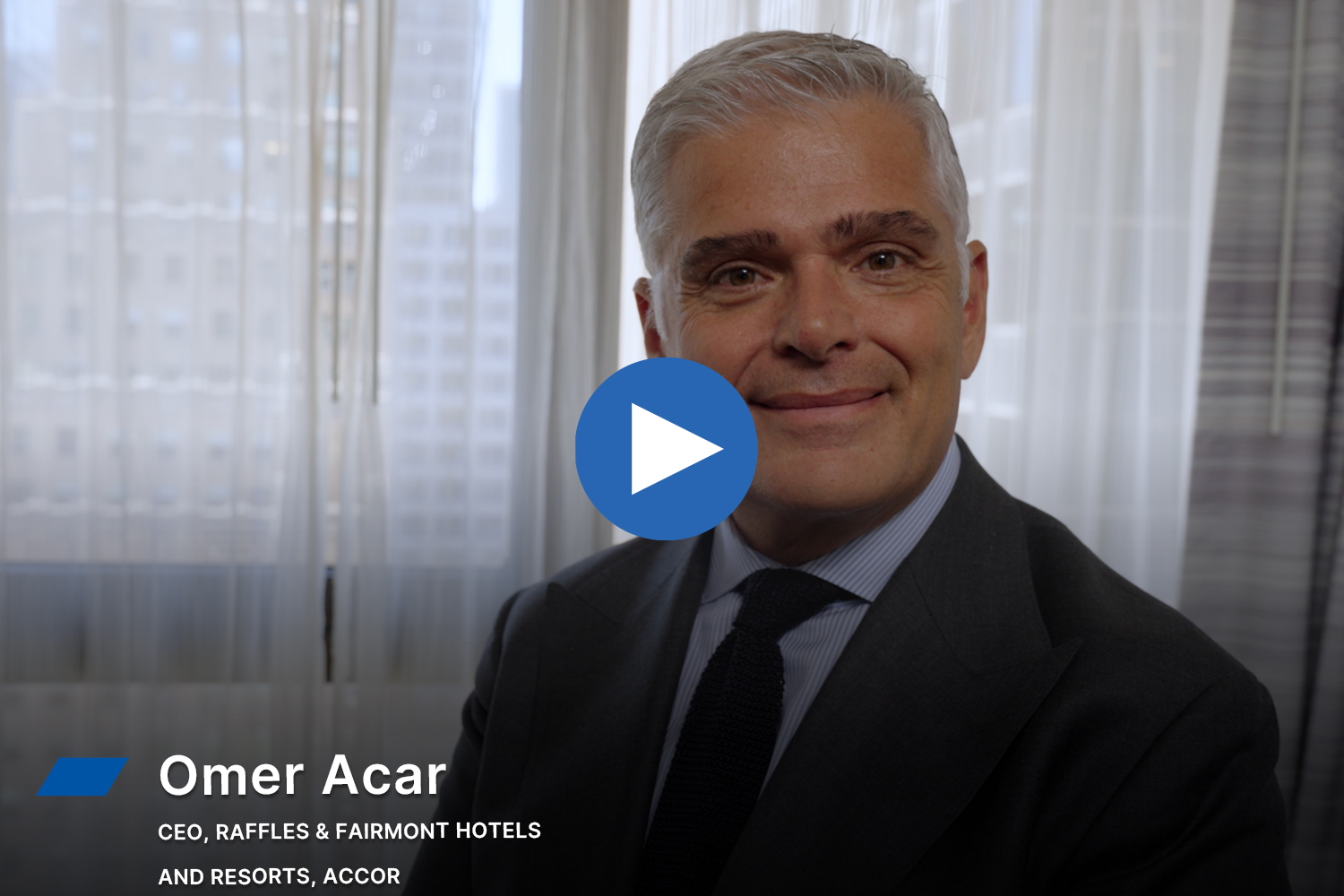
It’s a whole ecosystem, said Omer Acar, CEO of the Raffles and Fairmont brands at Accor. Wellness, retail, restaurants, and coffee shops all work together.
“It’s not anymore the hotel-only brand,” Acar said, adding he receives calls from hotel owners about which brands to put on the street front. “It’s not a one-off. It’s everything else.”
That point of curation of luxury developments is probably the most important thing that has emerged over the past few years, Goldstein said. Pointing to Zalaznick’s brands, Goldstein said they bring energy to their locations. Cain recently reopened the Delano Miami Beach, and as part of it, it brought in two Paris Society brands, Gigi Rigolatto and Mimi Kakushi.
“It’s really important to match the experience of the food-and-beverage operation with the brand,” he said.
The Delano Miami Beach features four total restaurant and bar concepts, including its Rose Bar, as well as a spa.
All of that needs to be wrapped together within a common theme of the brand, Goldstein said. In turn, that mix of inventory, attractions, and experiences has to balance with the customer and price point they're trying to achieve.
"I don't think you can in any way divorce the hotel from the lifestyle," he said.
Luxury hospitality brand Aman has a different philosophy in the uniqueness and sole nature of its operations in that it doesn’t want to be a destination in the same way, he said.
“What the hotel groups need to understand is that I think developers have gotten beyond listening always to the hotel groups saying, 'This is what we need in food and beverage terms,'” he said. “It’s much more of a partnership now. It’s much more of a discussion between the hotel brands and the developers that say, ‘What are we developing? What are we curating here?”
When working on hotel projects with owners, Accor listens to them and the developers, Acar said. It’s important to learn what their expectations are.
“It’s not sticking to one formula that everywhere we open a hotel, we’re going to have this and that, and that’s going to be it,” he said.
As long as he’s receiving calls from owners saying they’re happy, Acar knows his team is doing it correctly. One of the big parts of that is meeting their financial objectives, he said. Putting up a pro forma means delivering on the promise.
The other part is recognizing that ramping up food and beverage is different than a hotel ramp-up, he said.
“You get it right, or you don’t get it right,” Acar said. “It shows immediately, and you know when you can feel it. When you start questioning what else we need to do once you open, that’s usually the issue.”
DUHC&S | Strategic Hospitality Consulting & Advisory
We transform hospitality and tourism businesses through strategic solutions, operational efficiency, and comprehensive renovation. With over 40 years of experience working with brands like Hilton, Hyatt, Sheraton, and Sonesta, we enhance asset value and profitability through:
*Operational excellence and brand standards (GSI +90%)
*Market penetration and commercial strategies
*Key partnerships and disruptive innovation
*Hotel openings and repositioning
Proven results :
✅ 48% GOP |
✅ +120% asset valuation growth
✅ Successful projects across 6 Latin American countries
🔹 Let's connect :
📩 Email: diurugeles@gmail.com
📱 WhatsApp: +57 3153259968
🎥 YouTube:https://www.youtube.com/@DUHC-S
Instagram: https://www.instagram.com/diur_2000/
https://viajes-noticias-duhospitality.blogspot.com
https://viajes-duhospitality.blogspot.com
https://travel-duhospitality.blogspot.com
Disclaimer
DUHC&S shares this information for educational and informational purposes only. The news articles reproduced here are sourced from public and recognized media outlets. We are not the original authors of this content but rather its distributors. All credits go to the original sources cited in each article. If you are the legitimate owner of any material and wish to have it modified or removed, please contact us immediately at diurugeles@gmail.com, and we will address your request promptly.


Comments
Post a Comment