Hoteliers wrestle with hurdles to international inbound demand following World Cup
Hoteliers wrestle with hurdles to international inbound demand following the World Cup
Future of foreign travel in question with more mega events on the horizon

World Cup fans during the quarterfinal football match between England and Norway stop at at a fan zone in DUMBO (Down Under the Manhattan Bridge Overpass), a neighborhood in Brooklyn, New York, on July 11. (AFP via Getty Images)
https://www.costar.com/article/1402729834/hoteliers-wrestle-with-hurdles-to-international-inbound-demand-following-world-cup
Social media posts could lead one to believe that the 2026 FIFA World Cup was an overwhelming success for the United States, one of three host countries for the biggest iteration of the tournament in its history.
International tourists shared their thrilling newfound experiences at American superstore staples such as Walmart and Buc-ee’s and acquired tastebuds that yearned for ranch dressing. Those who decided to make the trip to the States seemingly enjoyed their stay and exposure to cultural touchpoints that make the U.S. a unique entity and tourist destination.
The data, however, points to flat year-over-year arrivals from international travelers during the tournament, a confounding fact given the global appeal of an event such as this one.
"You could argue ... that isn't this the perfect storm for international inbound? Isn't this when people really want to come?" said Jan Freitag, national director of hospitality analytics at CoStar Group.
Headwinds and hurdles surrounding travel to the U.S. potentially proved too bountiful to overcome this summer for the World Cup. Now, hoteliers and analysts alike question the strength of future of international inbound travel to the U.S. with the 2028 Los Angeles Olympics and more major sporting events on the horizon.
Hurdles in place
Joe Imbrogno, general manager of the Reverb by Hard Rock Downtown Atlanta, said his property didn’t experience a sizable surge in bookings from international travelers during the tournament. Those travelers accounted for between 10% to 15% of bookings related to the World Cup at his property, which is around the same amount it typically sees.
“From an international perspective, we didn’t really see a big impact,” he said. “Initially, the stay pattern was supposed to be people traveling internationally, staying for a long period of time and traveling from a base city — presumably Atlanta, since there [were] eight matches here, would be one of those, and Dallas probably another — which never happened.”
Imbrogno's hotel was expecting to see 30-day stays at a high rate, primarily driven by international travelers using the market as a base hub.
"What we ended up seeing was none of that," he said.
The actual result was high hotel demand in the day prior to a match and the day of a match before a stark decline in the immediate aftermath.
"We'd get really busy and then empty," Imbrogno said.
Rosario Bianchi, general manager of the AC Hotel by Marriott Downtown New York, said there’s recently been a softening in international demand from important feeder markets such as Canada and China. The level of international inbound demand New York City saw for the World Cup was lower than expected before the tournament.
Bianchi attributes some of this to complications of international tourists obtaining visas and other further unpredictability.
“We did get some folks that normally would visit, [but] there could have been some hurdles there,” he said.
Some of those hurdles include the current political landscape in the U.S. deterring potential travelers from making the trek.
The Iran war is largely unpopular among Americans — just 29% approve of President Donald Trump’s conduct in overseeing the war, according to a recent Washington Post-Ipsos poll — and the conflict is having widespread global effects on the supply chain. The constraints on the Strait of Hormuz have spiked oil prices, thus increasing the costs of travel.
Trump administration immigration policies are similarly unpopular — 40% of Americans approve to 59% disapprove. Immigration and Customs Enforcement officers continue to raid cities and make headlines, including two instances of killings over the past two weeks.
Four countries that participated in the World Cup are on the Trump administration's travel ban list. The Department of State paused immigrant visa issuances to applicants from 75 additional countries — including Brazil, Colombia and Egypt. Those who had purchased a ticket to a match could have scheduled an interview for a B1/B2 visitor visa through the FIFA Priority Appointment Scheduling System.
"The current policies of our government have made things very complicated," Imbrogno said. "People being detained at the airport or being denied visas — that obviously is a problem. I think those things also created a lot of fear, and so that probably deterred people."
There were hopes that these hurdles wouldn’t stand in the way of an event such as the World Cup, which involves 48 countries represented from around the globe.
The result, however, was underwhelming international inbound demand numbers.
According to International Trade Administration data, international air passenger arrivals to the U.S. increased just 0.2% year over year in June. For further context, the same metric decreased 6.6% year over year from June 2024 to June 2025.
Travel from Europe was down 1.2% annually in June after being down 2.8% in the month in 2025.
There’s a couple of ways to read the near-flat change in overall international inbound travel in June, Freitag said. The glass half-full approach is that June was only the second month since January 2025 to have a positive increase in international air passenger arrivals. Despite the largely underwhelming results for an event of this stature, it’s building a foundation for future travel to the U.S.
"The very positive read of this is this builds brand for the future, and eventually people are going to come back, and they're going to say, 'Oh, this was so fun,'" Freitag said.
For some World Cup fans, this could be the case.
"The good news is that for people that didn't have those issues and weren't afraid to take the trek, everything that I hear is that they've had an amazing time," Imbrogno said. "From what I see anecdotally online, I haven't heard of any negative experiences."
The glass half-empty take is if an event such as the World Cup can’t turn the numbers around, what will?
"That the European numbers are not up year over year when they were already down a year ago — I think that's just not great," Freitag said.
Taking notes for future events
There are three lessons to take away from the World Cup for hoteliers, Freitag said. First, hotel performance from these events is driven by rates, not occupancy. Second, booking patterns among eventgoers remained shortened and corporate group demand stayed away from host markets around match days.
"Even though people knew this was coming — the match pairings in the group stage were announced six months ago — we looked at our forward booking data, and it was lower than it was a year ago," he said.
Lastly, for the World Cup specifically, it was more like 104 separate events rather than one five-week event.
"There are ... peaks around the match days and then valleys again," Freitag said, referring to the hotel demand spikes.
All hope is not lost for the future of U.S. international inbound travel. Bianchi said while visa roadblocks and high fuel prices will continue to affect tourism numbers, the World Cup could still serve as a caveat for future trips.
"I want to say yes, it's definitely a springboard, and I think this definitely will help with future events, and hopefully we'll get people that actually came to experience the event to actually come visit another time," he said.
Another measuring stick for U.S. hoteliers is only two years away in the form of the 2028 Los Angeles Olympics.
"A good test will be Los Angeles because I think that they handle these kinds of events [well], and an international event would be really good to see how they do in '28," Bianchi said.
There are two messages international travelers are currently receiving, Imbrogno said. One alludes to the U.S. being unwelcoming, and one alludes to the U.S. being an amazing experience. How those messages evolve could determine the future of international inbound travel across the country.
"People are deciding which messages they want to listen to," he said. "Over time, hopefully the first set of messaging kind of normalizes and takes care of itself, and what people remember are all the good things, and longer term, that that will certainly encourage additional international visitation. I think at the moment, probably not."
What the higher-for-longer interest rate era means for hotels
Peachtree Group CEO Greg Friedman explains current financing environment

https://www.costar.com/article/657831304/what-the-higher-for-longer-interest-rate-era-means-for-hotels?
Despite a change in leadership, higher-for-longer interest rate policy seems to be sticking around at the U.S Federal Reserve, and Peachtree Group Managing Principal and CEO Greg Friedman said more hotel investors are making peace with that.
Speaking on the latest episode of the "CoStar News Hotels Podcast," Friedman said many, including himself, originally expected rates to stabilize "at a much lower level, which has impacted asset valuations in a material way.
"People have started to capitulate and realize that we are just in this environment where long-term rates will stay higher," he said.
He said the realization that rates aren't going back to the historic lows seen between the Great Financial Crisis and the COVID-19 pandemic has led some investors to look more seriously at borrowing at current levels.
"New financings were slow over the last several years, and now it's starting to pick up because people — owners and investors of real estate — are starting to realize this is the new normal," he said, noting geopolitical tension and inflation are unlikely to allow for much in the way of rate cuts in the immediate future.
While debt is more expensive than it was a decade ago, that doesn't mean borrowers have been unable to access capital. That's been in part due to private credit filling the gaps as traditional bank lenders have taken a step back. He said this led to a bifurcation in the market, where the most qualified borrowers, projects and assets had seemingly endless options, and everything else was "a little bit more challenging."
"If an asset has great in-place cash flows, there are no challenges on refinancing," he said. "It's when they lack the cash flows and the asset performance isn't fully recalibrated to this new interest rate environment where they're starting to have struggles because the asset values dropped and in a lot of cases they need to bring in additional liquidity."
For more from Peachtree Group's Greg Friedman, listen to the podcast embedded above.
Building leaders in the age of AI

https://www.mckinsey.com/capabilities/strategy-and-corporate-finance/our-insights/building-leaders-in-the-age-of-ai
By
Leadership is always critical—but AI is making it more important than ever.
Artificial intelligence can write, design, code, and complete tasks at breakneck speed. It can help business leaders draft emails, create agendas, and quickly prepare for important meetings and difficult discussions.
It can do all of that with just a few voice commands—but it still can’t do the hard work of leadership itself. Generative AI cannot set aspirations, make tough calls, build trust among stakeholders, hold team members accountable, or generate truly new ideas.
That work remains deeply human—and more important to get right than ever before, given the scope of change and uncertainty with which today’s organizations are dealing.
The leaders who end up thriving in the AI era will be those who blend human depth with digital fluency. They will use AI to think with them, not for them. And they will treat this AI moment not as a threat to their leadership but as an opportunity to focus on those elements of their portfolios that only humans can excel at.
The core shift: From “command” to context
Recent McKinsey Global Institute research on skill partnerships in the age of AI suggests that people, agents, and robots will increasingly be working side by side to facilitate workflows. In this environment, CEOs and other C-suite leaders will not always be the smartest people in the room. As a result, traditional command-and-control approaches are likely to fall flat. It will be much more important, instead, for these leaders to create the context in which their teams can successfully navigate AI-informed process changes, role changes, and other internal and external business disruptions.
Leaders will need to give teams a set of guardrails (clear values and decision rights) and establish new definitions of quality while fostering a sense of trust and collaboration as new challenges emerge and business conditions evolve. There are three areas, in particular, where only humans can provide the type of leadership and guidance required in today’s organizations:
1. Setting the right aspiration—and enrolling others to own it
Aspirations are uniquely human; a robot cannot set an ambitious goal for an entire organization, whether targeting high performance, innovation, or growth. Leaders can “read the room” and anticipate and interpret emotional reactions to change, which is critical for understanding how best to mobilize people and enroll them in the organization’s strategic plans. Only an empathetic leader can identify preferences and map the right people to the right projects. Leaders can of course use agents and machines to help draft their messaging, but they cannot delegate aspiration setting.
2. Demonstrating judgment—aligning choices to values
The ability to show good judgment is a distinctly human trait. AI can summarize rules or outline risks, but its role is advisory, not authoritative. And while AI models can analyze and create structure around arguments, they don’t ultimately bear any responsibility for their outputs. By contrast, leaders in the physical world must be accountable to their employees, boards, investors, business partners, and other important stakeholders. They must make the hard calls when an organization’s values are in conflict and time is short. McKinsey’s research on organizational health shows that leaders’ decisiveness, accountability, and demonstration of good judgment can not only unlock trust and loyalty across teams but are also a key predictor of companies’ ability to create long-term value.
3. Designing for nonlinear outcomes—not 20 percent, but 10 times better
In a world where global, societal, and technological forces are changing so dynamically, the ability to foster novel and creative ideas is becoming a critical leadership muscle: Leaders must continually review, revise, and create new architectures, narratives, and conditions for their organizations. This is the antithesis of “playing not to lose.” The AI models that leaders are using are inference engines, optimized to generate the next most probable continuation of patterns the models have seen. But only human leaders can recognize when AI outputs will lead to actual breakthroughs for an organization. They must do the hard work of framing—that is, set an audacious brief, define the guardrails, invite dissent, and then hold the creative line when early iterations are messy.
Identifying and developing your high potentials
Aspiration, judgment, and creativity are “only human” leadership traits—and the characteristics that can provide an irreplaceable competitive edge, especially when amplified using AI. It’s therefore incumbent upon organizations to actively identify and develop the individuals who demonstrate critical intrinsics like resilience, eagerness to learn from mistakes, and the ability to work in teams that will increasingly include both humans and AI agents. As McKinsey explored in its research on the CEO as elite athlete, these characteristics are strongly linked to sustained performance and are a better predictor of long-term success than credentials alone.
While identifying high-potential employees, senior leadership teams may need to tear through the “paper ceiling” in their organizations—that is, where the lack of formal credentials prevents individuals from being hired or advancing. This will require looking beyond academic degrees and certifications when vetting candidates and emphasizing skills-based hiring, relevant real-world experience, and the intrinsics that travel across roles and technologies.
Best-in-class companies are already focusing more on the skills that a job requires and that a candidate possesses. They are implementing a fundamentally different assessment system, one that is more audition than interview: live scenarios with incomplete information, structured questions that test value-based judgment, and rapid stretch-role moves that reveal trajectory.
Building the next generation of leaders
If the role of the leader is evolving, then so must organizations’ approach to building their leadership bench. The goal here should not just be to develop leaders who have technical fluency; mastery of the human condition is just as critical in a world where models can draft, reason, act—but cannot lead.
Previous McKinsey research on the art of 21st-century leadership and the importance of building and scaling a robust leadership factory points to four imperatives for leaders in the age of AI:
Know what attributes you’re looking for. Make explicit the leadership attributes your company needs right now and the behaviors you will reward. If economic and competitive shocks are particularly frequent or particularly acute in your industry, for instance, you may want to focus on resilience and optimism as the key character attributes to find and build in your high-potential employees.
Create a step-change in learning culture—learn a little, test a little, learn a lot. Establish a culture in which premortems, after-action reviews, and other feedback mechanisms are the norm rather than the exception. This has long been the standard approach in the software industry and the medical community: achievements are celebrated, failures are painstakingly reviewed, and lessons are codified. Former Intuit CEO Brad Smith would schedule regular meetings with employees who were several levels down in the organization and would ask them: What’s getting better, what’s going in the wrong direction, and what’s something you’re afraid no one is telling me that I need to know right now? “It was incredible,” he recalls, “because you skip levels and go right to the front lines of the area you’re trying to learn about. You cut everybody else out and eliminate the filter.”2
Senior leaders can show their commitment to creating learning environments by engaging directly with high-potential employees, in forums or town halls, to share questions and crowdsource answers to some of their biggest management challenges.
Invest in building trust and servant leadership. Organizations must actively cultivate core leadership qualities such as wisdom, empathy, and trust—and they must give the development of these attributes the same attention they do to the development of new IT systems or operating models. That will mean providing time for leaders to do the inner work required to lead others effectively—that is, reflecting, sharing insights with other C-suite leaders, and otherwise considering what success will mean for themselves and the organization. How can they build and sustain organizations that can remain viable long term? In A CEO for All Seasons (Scribner/Simon & Schuster, 2025), Microsoft CEO Satya Nadella recalls an important lesson from his father, a civil servant in India, who emphasized the importance of mentoring and meaningful transitions: “I feel that if the next CEO of Microsoft can be more successful than I am, then maybe I’ve done my job right.” Indeed, as a sign that the leadership journey is just as important as the outcomes, organizations should publicly celebrate or promote leaders who demonstrate a commitment to the organization’s broader mission rather than self.
Protect your time and energy for sustained performance. The highest-performing leaders create conditions that allow them to reach their personal best at peak moments; they recognize that, over the course of their leadership tenures, some moments are simply more important than others—so they optimize for those critical inflection points. They fiercely protect their calendars, so they can focus on tasks that only they can do, and they carve out time explicitly for recovery and regeneration. For instance, one global tech CEO keeps 20 percent of his calendar empty so he can catch his breath and respond appropriately to situations as they arise.3
Leadership is ultimately a uniquely human endeavor.
AI may transform how we work, but only human leaders can determine why we work and what we’re trying to achieve.
Indeed, the ultimate competitive advantage for organizations in this AI era won’t be based solely on the algorithms they create—it will also be based on the authentic, adaptive, and accountable leaders they develop.
India’s luxury hotels were already performing well—then they got a boost from the prime minister.

https://hotelsmag.com/news/indias-luxury-hotels-were-already-performing-well-then-they-got-a-boost-from-the-prime-minister/
Geopolitical pressure, uncertain inbound travel and a cautious global mood were still not enough to stymie India’s luxury hotel performance in 2025, something that has also carried over through this year.
Consider The Leela Palaces, Hotels and Resorts. It posted strong results in first-quarter 2026, with revenue per available room increasing 6% year over year. Average daily rate increased by 14% and EBITDA rose by 19%. “Our RevPAR outperformance at about 2.3 times the luxury segment continues to deliver market share gains, underscoring our pricing power,” said CEO Anuraag Bhatnagar.
Domestic tourism in India is showing clear signs of a broader resurgence.
Travelers who might have booked overseas summer holidays are instead choosing destinations within India that are helping shore up the country’s economy. Several hospitality operators confirmed the trend, reporting sharp improvement in occupancies and room rates from May 2026 onward.
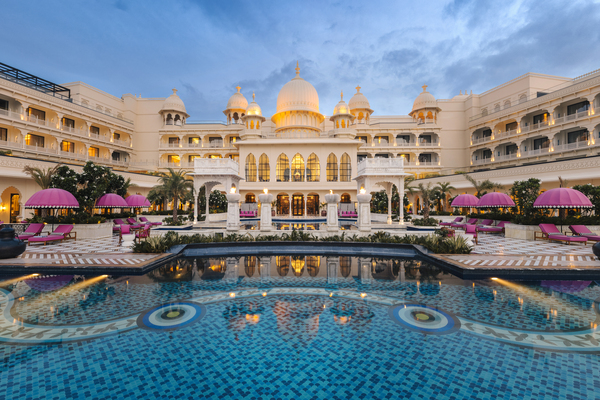
The Fairmont Udaipur Palace is an 18-acre, modern Rajput-Mewar estate set in the Aravalli Hills.
They may have their prime minister to thank. At a public event in Hyderabad on May 10, Prime Minister Narendra Modi made an unusual appeal to ordinary Indians, asking them to put foreign travel plans on hold. It was not a policy announcement or a government directive; rather, a personal appeal, the kind a leader makes when a situation feels genuinely urgent. India’s luxury hotel industry players say the shift in sentiment is already benefiting domestic hotels, resorts, homestays, airlines, spiritual tourism circuits and regional travel destinations.
The government’s backing goes well beyond a plea. India’s Union Budget 2026 to 2027 designates tourism as a high-impact growth sector, with targeted investment flowing into destination development, cultural revitalization and hospitality infrastructure. The government’s Vision@2047 program, which aims to attract 100 million foreign visitors, is directly stimulating hotel development across the country.
Indian policy-driven initiatives, which include Buddhist circuit developments, medical tourism hubs, eco-trail corridors and cultural circuits, are generating consistent room demand in areas that previously saw less hospitality investment. Government-backed airport expansion and improved domestic connectivity have further reinforced demand.
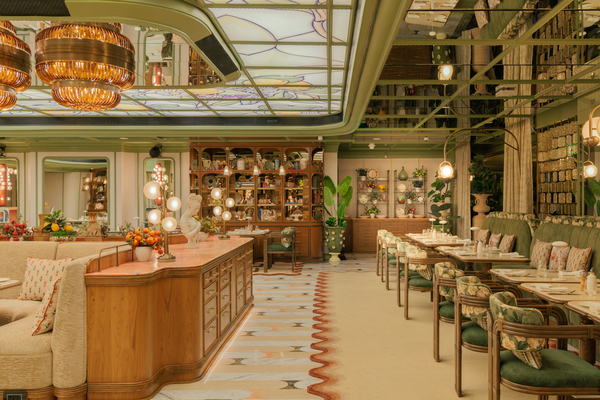
Fi’lia at Roswyn, Morgans Originals Hotel in Mumbai.
OPENING UP
Accor, one of the leading luxury lodging purveyors in India, opened Fairmont Mumbai last spring, a 446-room property featuring five restaurants, a grand ballroom with capacity for more than 2,000 guests and a wellness suite combining cryotherapy and hyperbaric oxygen with Ayurvedic healing. Months later, Fairmont Udaipur Palace opened across 18 acres of lakeside grounds, with 327 rooms and more than 130,000 square feet of event space. Udaipur has since become one of India’s primary addresses for luxury weddings and large-scale destination events. Accor has set a target of 300 hotels in India by 2030.
“India is central to Accor’s long-term growth strategy because it combines three factors that are rarely present at the same scale: a large growing domestic travel base, a fast-expanding affluent consumer segment and a strong demand for more high-quality branded hotels across gateway cities, resort destinations and emerging leisure markets,” said Amitabh Rai, COO, luxury, Accor, South Asia. Rai said that the market size of the country’s hospitality industry is expected to grow from $282 billion in 2025 to $541 billion by 2030. “In terms of luxury, that opportunity is further underscored by encouraging dynamics, including the growth in the number of high- and ultra-high-net-worth individuals.
Accor’s CEO, Sébastien Bazin, is as bullish as his deputy. At a recent investment conference, he said he expected India to be the largest market by 2045, “bigger than China.”
Accor’s luxury pipeline is robust. In Goa, Accor and the Dangayach Group announced Raffles Goa Shiroda and Fairmont Goa Shiroda, planned for 2030. In Rajasthan, Raffles Ranthambore and Sofitel Legend Sukh Bagh Jaipur have been announced. “These projects are aligned with where luxury demand is moving,” Rai said.
Luxury properties in India reflect a cultural touchpoint, representative of the idea that guests are more than just visitors: They are a blessing. The same sentiment has been present for ages in phrases like “Padharo Mhare Desh” and “Atithi Devo Bhava,” the former a greeting with outstretched arms, the latter with holy reverence. The modern Indian luxury traveler, as Accor has assessed, is well travelled, globally aware and no longer impressed by excess for its own sake. At Fairmont Jaipur, that philosophy transforms into village walks through rural Rajasthan, connecting guests with local craft, pottery and home-cooked food. At Fairmont Mumbai, it surfaces through recovery therapies drawn from cutting-edge science and ancient Indian healing traditions.
“We are extremely optimistic about the future of luxury travel in India. Demand is expanding beyond metros and the traditional gateway cities,” said Rai. “It presents a significant opportunity for hospitality brands to develop experiences that are both globally relevant and locally authentic.”
At Leela, properties in the pipeline include hotels in Coorg and Jaisalmer, each designed to reflect its destination’s specific character while meeting global luxury service standards. Considering that India’s millionaire households are projected to grow at a compound annual rate of roughly 17.5%, Leela is building for the guests those households will produce.
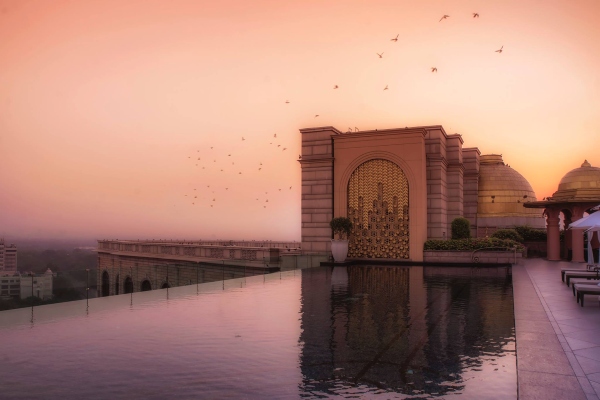
The Leela Palace New Delhi is located in the diplomatic enclave of Chanakyapuri and is known for its opulence, including Venetian Murano chandeliers.
“While global travel sentiment remains dynamic amidst an evolving macro scenario, we see the current environment as a shift in demand mix rather than a slowdown,” said Bhatnagar, citing strong macroeconomic tailwinds, rising wealth and a growing preference for experience-led travel. He said that domestic demand remains resilient, with strong traction from affluent Indian travelers across staycations, celebrations, premium leisure and corporate offsites. “Any near-term moderation in outbound travel is likely to further support domestic demand across key leisure and heritage destinations,” he said.
For travelers planning to take advantage of the moment, timing matters. October through March remains the most comfortable window for most of the country. Diwali and Holi, both of which fall within that range, represent India’s two most popular and most vibrant travel periods. Beyond that peak window, the monsoon season offers lower rates and smaller crowds at Ayurvedic resorts and heritage hotels, while April and May are considered the best months for wildlife viewing as diminishing vegetation concentrates animals around remaining water sources.
Other India-based luxury lodging companies are taking advantage of the upswing, too. Oberoi Hotels opened The Oberoi Vindhyavilas Wildlife Resort, Bandhavgarh last March. The property, which features only 19 luxury tents and two pool villas, is set within a 21-acre forested expanse minutes from Bandhavgarh National Park. Oberoi is slated to open a property in Saudi Arabia later this year in the Wadi Safar development near Diriyah.
DUHC&S | Strategic Hospitality Consulting & Advisory
We transform hospitality and tourism businesses through strategic solutions, operational efficiency, and comprehensive renovation. With over 40 years of experience working with brands like Hilton, Hyatt, Sheraton, and Sonesta, we enhance asset value and profitability through:
*Operational excellence and brand standards (GSI +90%)
*Market penetration and commercial strategies
*Key partnerships and disruptive innovation
*Hotel openings and repositioning
Proven results :
✅ 48% GOP |
✅ +120% asset valuation growth
✅ Successful projects across 6 Latin American countries
🔹 Let's connect :
📩 Email: diurugeles@gmail.com
📱 WhatsApp: +57 3153259968
Instagram: https://www.instagram.com/diur_2000/
https://viajes-noticias-duhospitality.blogspot.com
https://viajes-duhospitality.blogspot.com
https://travel-duhospitality.blogspot.com
Disclaimer
DUHC&S shares this information for educational and informational purposes only. The news articles reproduced here are sourced from public and recognized media outlets. We are not the original authors of this content but rather its distributors. All credits go to the original sources cited in each article. If you are the legitimate owner of any material and wish to have it modified or removed, please contact us immediately at diurugeles@gmail.com, and we will address your request promptly.


Comments
Post a Comment