Trump Administration’s Yosemite Plan Is an ‘Attack on the American People’
Trump Administration’s Yosemite Plan Is an ‘Attack on the American People’

Andrew Opila/iStock
https://www.fodors.com/news/news/trump-administrations-yosemite-plan-is-an-attack-on-the-american-people
The Trump administration has proposed a land swap that would give a private developer access through Yosemite National Park, sparking fierce opposition.
The Trump Administration has proposed handing over a portion of Yosemite National Park to a private developer in exchange for land of equivalent value, the New York Times reported last week.
The proposal calls for the National Park Service (NPS) to transfer a small parcel of land inside the park to the real estate private equity firm Kingsbarn Realty Capital, so it can build a road and access the park more conveniently from two 40-acre parcels it wants to develop for visitor lodging. Kingsbarn would purchase land of equivalent value and transfer it to the Park Service in exchange for the land, said the documents submitted to Congress earlier this year.
The road would give any future lodging property extraordinary private access to the park. The property currently sits around ten miles away from a regular park entrance, and up to 90 minutes away from the park’s most popular scenic attractions. A direct entrance to the park from the property would significantly increase the value of the land and the commercial viability of any lodging built there.
NOTUS, a digital news outlet that originally broke the story, also reported that NPS officials, speaking under the condition of anonymity, said that the top political appointees at the Department of the Interior had instructed them to work with the developer as a top priority. Previous developers have also attempted to have a road built from the property, but Interior under the Bush, Obama, and Biden administrations all declined the request.
Reports of the plan drew swift condemnation from California’s two Senators, former park officials, and the National Park Conservation Association, a hundred-year-old nonpartisan advocacy group for US national parks.
“The Trump administration’s attempts to dismantle America’s conservation legacy are now taking aim at Yosemite with this secretive, backroom deal that would turn over Park Service land to a private developer. This is an attack on the American people who own this national park. It would also be unlawful, and a court previously rejected a road development proposal,” said Mark Rose, senior Sierra Nevada program manager for National Parks Conservation Association in a statement provided to Fodor’s.
“The National Park Service needs to get back to prioritizing conservation, not helping bulldoze land, cut down trees, threaten Yosemite’s wildlife and increase wildfire risks,” Rose added.
A spokesperson for the Interior Department, the parent agency of the Park Service, said in a statement to The New York Times that the proposal is still in the initial stages.
“Any land exchange or access proposal involving National Park Service lands would be subject to all applicable federal laws, regulations and departmental policies, including required environmental review and public notification processes,” the spokesperson said.
Both of California’s senators told The New York Times they opposed the proposal and were working on the Senate Appropriations Committee to block it.
“This is the most corrupt administration in history,” Senator Alex Padilla (D-California) said in a statement to The New York Times. “The Land and Water Conservation Fund exists to acquire land and interests in land in order to safeguard natural areas, water resources and cultural heritage—and to provide recreation opportunities for all Americans.”
The proposal was absent from a list of endorsed projects Senators Lisa Murkowski (R-Alaska) and Jeff Merkley (D-Oregon), the chair and ranking member of the Senate Appropriations subcommittee, sent to Interior with oversight of the Land and Water Conservation Fund earlier this year.
An order to swap the land is almost certain to face legal challenges if it becomes final.
It’s been a difficult year for the country’s national parks, with reports of understaffing, overcrowding, and, alternatively, reduced visitation.
The new management playbook for AI: How to move faster and create more value

https://www.mckinsey.com/capabilities/tech-and-ai/our-insights/the-new-management-playbook-for-ai-how-to-move-faster-and-create-more-value?
By
There is a new management playbook emerging for how to run companies better in the age of AI.
The companies that are truly innovating with AI aren’t winning just because of the tech they use—those tools are broadly available. Their advantage comes from how, and how fast, they apply technology to solving real business problems at scale. That requires new organizational capabilities that take time to build.
In the end, those capabilities become the true long-lasting competitive advantage that enables these companies to sustain a higher rate of innovation with technology.
We studied 20 companies that have consistently created significant economic value from their business transformation enabled by AI. These companies, many of which are profiled in the second edition of our seminal book, Rewired: How Leading Companies Win with Technology and AI, aren’t the wunderkind tech companies that are always in the headlines. They are large businesses that have invested the time to build up their tech and AI capabilities to successfully turn tech into value.
Game-changing impact with AI is already a reality
Our most recent State of AI report reveals that 94 percent of businesses have yet to create meaningful value. The math is unforgiving, and it underscores the skepticism that many boards and top teams have about making the level of investment necessary for successful business transformation with AI.
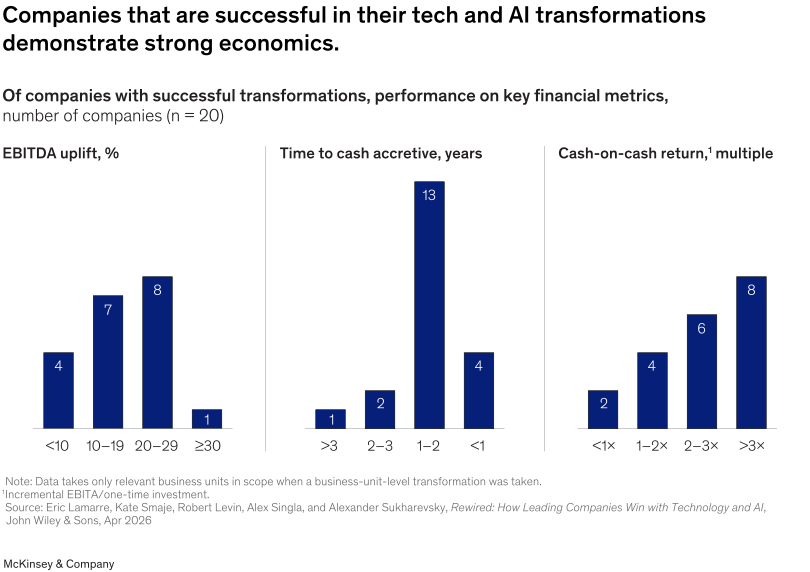
A small number of companies, however, have shown radically different outcomes. For each of the companies we studied, we reviewed the transformation road map and financial outcomes. We also interviewed select executives to gather additional details and insights. This analysis helped us answer important questions we are frequently asked about the economics of successful business transformation with tech and AI (exhibit).
Exhibit
We strive to provide individuals with disabilities equal access to our website. If you would like information about this content, we will be happy to work with you. Please email us at: McKinsey_Website_Accessibility@mckinsey.com
These leading companies shared the following notable traits:
- They achieved game-changing bottom-line impact. We looked at the steady-state EBITDA achieved by these transformations after three years as a percentage of the company's EBITDA. If the transformation was focused on a particular division or business unit, we focused our analysis at that level. The 20 companies in our sample improved their EBITDA by 20 percent on average.
- They focused on key economic leverage points. Two-thirds of the companies focused on three business domains or fewer. These business domains were always key economic leverage points where even small improvements by AI translated into material financial impact. For example, Freeport-McMoRan focused on process yield and throughput, a classic leverage point in mining. LATAM Airlines Group focused on passenger experience.
- They built AI systems, not point solutions. These companies didn’t approach their transformation by just pushing a single technology lever (like gen AI). They defined the problem to be solved, and from there they designed an AI system to improve business performance. These systems were composed of different solutions and underlying technologies. Toyota used machine learning to optimize forecasting, agentic workflows to support supply planners, and digital workflows to provide supply chain transparency to dealers and customers, among other solutions. Just as important, these systems also contained non-technology elements such as improving data quality, changing work practices, and realigning incentives.
- They became cash accretive quickly. These 20 companies became cash positive in one to two years on average. While they took longer to realize the full benefit (typically three to four years), they were smart in sequencing the build of their AI system to deliver low-hanging fruit that paid for the journey.
- They made substantial investments and achieved high returns. We measured the cash-on-cash return as annual incremental EBITDA divided by one-time cash investments. On average, for every $1 of investment, these companies realized $3 of incremental EBITDA. These extraordinary returns are the result of focusing efforts on economic leverage points rather than pursuing a “thousand flowers bloom” approach to AI. These companies made substantial investments in transforming their business with AI, often in the range of $50 million to more than $200 million.
Interestingly, despite notching such amazing successes, these companies are still at it. Improving business performance with technology never stops. They typically go through waves of transformation that last two to four years. Freeport had its first large-scale AI breakthrough in 2018 when it created step-change productivity improvements in its copper concentrators. Three years later, leveraging that newly developed “muscle,” Freeport repeated its prowess in leaching.
Building the system: The capabilities needed to transform businesses with tech and AI
The ability of an organization to harness technology for business value is the competitive advantage, not the technology itself. We identified six core capabilities that successful companies build.
These six capabilities do not operate independently; they reinforce each other. They also take time to build. Our four exemplar companies have been at this for more than five years, and they are still at it. No company becomes an overnight AI success. But once a company has developed these capabilities, it has a real competitive moat.
A C-suite team that gets AI
A C-suite that understands AI is the most significant driver of success.
Successful top management teams understand that to create value with technology, they must focus their AI efforts where it matters, and they must use AI in a competitively differentiated way. Doing so requires strategic creativity to see what others do not. That’s hard.
At DBS Bank, the top team spent significant time in Silicon Valley and with digital natives to understand what truly differentiated high-performing tech firms—not tools, but capabilities: modern engineering practices, platform-based architectures, data at scale, agile ways of working, and a culture of continuous experimentation. This wasn’t a superficial benchmarking exercise; it led to a fundamental reframing of DBS’s technology operating model. The result was a multiyear commitment to build these capabilities systematically so that technology could consistently drive speed, innovation, and customer value.
This work cannot be assigned to a single executive or delegated further down the organization. This is the hard work that the top team must undertake, together.
Leaders on the front lines of change who have tech and AI muscles
Because AI is so deeply embedded in a company’s operations and workflows, harvesting value from AI requires leaders who combine deep domain expertise, an understanding of technology and data, and an ability to orchestrate end-to-end change.
When Freeport decided to go all-in on its leaching optimization system, it tapped a leader with both experience in operationalizing AI-based solutions and credibility in processing operations. It relocated him to be the general manager of its leaching operation. As effectively the domain owner, he led the development of the AI system, integrated the different technology solutions into business operations, and was ultimately accountable for the business outcomes.
This is a consistent finding in our success stories: There is always a senior business leader3 who leads and integrates business, technology, and the change management aspects to achieve breakthrough outcomes. Of all the AI upskilling programs a company might launch, none will be more strategic and impactful than developing tech-capable business leaders. This is where companies that are leading with AI today are devoting serious effort.
This updated edition offers brand-new insights into cutting-edge AI solutions—and what it takes to implement them—as well as the new economics of digital and AI transformations.
An operating model built for speed
Rewired organizations embed tech delivery capabilities in the business to drive more effective and faster innovation cycles. They build platform capabilities to maximize reuse and support faster business innovation. DBS Bank organizes work around end-to-end customer journeys such as opening an account, buying a home, or securing small business financing. Cross-functional teams are aligned to these journeys and are accountable for delivering seamless customer outcomes across channels and products. Rather than working within functional silos, these teams orchestrate capabilities from the underlying platforms (more on platforms below) to solve specific customer needs. The benefit is sharper customer focus with faster cycle time, better conversion, and increased customer satisfaction.
The bank is also structured around a set of enterprise platforms such as payments, customer data, onboarding, and credit. Each platform brings together business, technology, and operations and is funded as a long-term asset rather than a series of projects. These platforms build reusable capabilities—APIs, data assets, and services—that can be leveraged across multiple parts of the bank. The benefit is scale and speed.
This is what we call a distributed operating model because teams close to the business can build, test, and improve solutions iteratively. Every success story we have documented has a version of this operating model, yet only 10 percent of companies have adopted one. Why? Rearchitecting a company around such a model requires vision and resolve.
‘Technology as a platform’ to power the enterprise
When LATAM Airlines was embarking on its transformation journey, it made a deliberate decision to build customer-facing capabilities separately from its legacy core and in the cloud. This was not simply a technology choice; it was a strategic architectural commitment. The new digital organization was designed to be API-first and modular from the outset, with reusable components and open integration layers.
Because solutions were built API-first and modularly, they could be reused across channels and geographies. An order-change capability developed for the web could be deployed to the app, contact center, or WhatsApp without rebuilding core logic. When scaling to new markets with different payment systems and regulatory constraints, LATAM used abstraction layers to integrate or swap external systems without destabilizing the platform. What could have become a patchwork of local customizations remained coherent.
Well-architected technology platforms accelerate everything: product launches, automation, data reuse, AI deployment, resilience, and more. Weak platforms slow everything down and tax the business with hidden costs through complexity, fragility, long cycle times, and dependence on a few heroic individuals who “know how the system works.”
The shift from siloed systems to platforms is one of the most important strategic capabilities that rewired companies have built. If you aspire to be a CEO—or remain an effective one—you must treat your technology platforms with the same rigor and ownership as your business strategy or succession plan.
Data that’s easy to consume
In 2018, it took DBS 15 to 18 months to develop and deploy AI models. Data was stored in different silos across the business, which meant it took months just to locate the data and get access permissions. Even when teams did get access, discovering how the data was structured and assessing its quality became a project of its own. Eventually teams managed to build one-off data pipelines that couldn’t easily be reused by other teams.
That just wouldn’t do. So, DBS embarked on a journey to develop a unified data platform as well as an AI platform, automate data access controls, and make data easy to both discover with metadata and to consume through data products. It aligned its data governance around the leadership of its different business domains, ensuring data was really managed as an enterprise asset.
Building this capability paid off. By 2023, it took just two to three months to deploy AI models. This ease of data consumption became central to unlocking an estimated more than 1 billion Singapore dollars (nearly US $772 million) in value generated from AI.
Designed for scale from the beginning
AI systems create value only when they are adopted and scaled. That may sound obvious, yet it remains one of the hardest challenges.
Adoption often fails because adjacent upstream and downstream processes are left unchanged. When Freeport developed an AI pilot to boost copper recovery through leaching, it created data and sensor standards so that the data could be easily ingested into a cloud data platform built for an earlier program and then reliably modeled in a consistent way across all of its assets.
Scaling is a different, but equally difficult, challenge. Expanding AI solutions quickly and economically across markets, factories, customer segments, or product lines requires modular solution architectures and a well-choreographed “dance” between central teams and the receiving units. Freeport solved this problem by recognizing that 60 percent of the AI system could be reused across plants while 40 percent would require local adaptation. This informed how to organize the central team that maintained the shared assets and the field team that ensured local adaptation.
The capability of an organization to manage these adoption and scaling challenges gets built over time as the company learns. Eventually, a success playbook emerges inside the company and continues to evolve with new technologies such as agentic AI.
Foundational capabilities are the secret to building greater speed
The companies that pull ahead do not treat early AI wins as end points. They know that competitors will eventually replicate their success. These companies constantly improve their AI systems with better data, more sophisticated models, real-time responsiveness, deeper orchestration across related workflows, richer customer/user experiences, and so on.
The companies that win that innovation race have capabilities that grow as technology and managerial practices advance (table).
Table
Successful companies constantly evolve their AI capabilities.
| Stage 1: First wins | Stage 2: Scaling value | Stage 3: Agentic AI enterprise | |
|---|---|---|---|
| Business-led road map | Point solutions | End-to-end business domains transformation | AI systems: cross-domain, real-time, automated |
| Talent | Software and data engineering | Tech-capable business leaders and upskilled IT organization | Upskilled to build and run agentic systems |
| Operating model | Agile | Domain and platform model | Agent–human model, flatter organization, smaller teams |
| Technology | Cloud and modern software development | Decoupled architecture and enterprise platforms | AI-driven software development life cycle |
| Data | Data lake | Unified, productized, and easy to consume | Meaning and context; enrichment of data moats |
| Adoption and scaling | User experience design | Reconfigured processes and solutions architected to scale | Orchestration layers and automated guardrails |
The companies profiled in this article have largely mastered stage 2 and are now actively developing stage 3 capabilities.
We are in the early innings of stage 3. The next few years will see fast maturation of these new agentic capabilities. The companies that master them will compound even more advantage over peers that don’t.
The question is no longer whether AI will reshape your industry—it already is. The real question is whether your organization is building the capabilities to shape that future or simply react to it. The companies pulling ahead are investing now to build the muscles that allow them to repeatedly turn technology into business value.
Hotel revenue managers preach ability to pivot amid volatile economy
Summer performance peaks required flexibility, but stable group season nears

Hotel revenue experts shared why strategists need to be nimble to roll with the up-and-down nature of hotel demand, though the more stable group business season is near. (Getty Images)
https://www.costar.com/article/1702278288/hotel-revenue-managers-preach-ability-to-pivot-amid-volatile-economy
NASHVILLE, Tennessee — The hotel industry is often cyclical in nature. The past couple of years, however, have been marked by constant volatility in the headlines.
This year has mostly been a positive one following a disappointing 2025, but optics can change rapidly as global headwinds appear out of thin air on a normal cadence.
Allison Frazier, vice president of revenue management at Atlanta-based Peachtree Group, used a familiar phrase to describe her current feelings on the state of the hotel industry.
"I feel cautiously optimistic. It's been a really, very good first half of the year," she said during a revenue management roundtable discussion hosted by CoStar News Hotels at the recent Hotel Data Conference. "I think that it's still volatile. There's still a lot of political things and things with the economy ... that's why I like the word 'cautiously' because I feel like things can change very quickly."
Linda Gulrajani, vice president of revenue strategy and distribution at Milwaukee-based Marcus Hotels & Resorts, said she's also "cautiously optimistic." Marcus Hotels' portfolio skews toward the upper-end of asset types, which is "the sweet spot right now" for hotel demand, she added.
One source of the optimism comes from the strength of group travel.
Lynsey Kreitzer, executive vice president of commercial strategy at New Hampshire-based management company Lark Hotels, said the sweet spot for group travel has been smaller events — those with under 200 people — that bring in a higher dollar amount per person.
Group performance has been one of the key contributors to Peachtree's year-over-year growth and success, Frazier said, also noting how smaller groups are traveling more.
Like a lot of areas of the hospitality industry, it comes with a caveat, though. While group pace has been strong, banquet contribution from those groups has not, Gulrajani said.
"That's been kind of a standout for us this year across most of our hotels, where we're getting the group, but we're just not getting the food-and-beverage spend that we used to get or expected from it," she said. "We really have to think hard about what's our strategy for next year, and that's hugely important to some of our big group hotels."
Much has been made about the so-called "K-shaped economy," referring to high-income earners continuing to grow their wealth while low-income earners make less. This phenomenon has led to a bifurcation in travel demand among asset classes, with luxury and upper-upscale hotels performing well while economy and midscale hotels lag behind.
High-income earners have been prioritizing experiences over material goods in recent years, a trend that Kreitzer believes will continue.
"One thing I don't think is going away, which we've seen since COVID, is that people are trading in possessions for experiences," she said. "I do think people are doing that, and I love that for us because then we can really pour into those high-intent travelers that are like, 'I want to experience X, Y, Z when I'm at that location.'"
More travel demand is obviously a good thing for U.S. hotels, but hoteliers then need to be ready to meet the moment and quench the thirst for those experiences.
"On the flip side, we have to rise to the occasion and provide the experience," Gulrajani said.
There are some key broader economic metrics that the hotel industry has recently broken away from, Gulrajani said. Unemployment numbers and U.S. gross domestic product used to correlate more with hotel demand, but that hasn't been the case in recent years.
"I feel like the world's a little bit of a contradiction right now. There's all these macroeconomic things happening, and the hotel business — at least the higher end — is not following what some of the things would tell you," she said. "I do think things have changed a lot, but that macroeconomic piece still could impact the hotel industry down the road."
World Cup as a case study
There's perhaps no better example that encapsulates the current state of the hotel industry than the 2026 FIFA World Cup.
Back in the fourth quarter of 2025, there was incredible hype surrounding the potential hotel demand the World Cup would bring to the U.S. As the months went by and the tournament drew nearer, that hype fizzled as forward bookings remained absent. The actual result was a positive boost to summer demand, but not at the levels it was once anticipated to be.
This volatility in perception is a microcosm of what the industry at large has been facing over the past few years, as there are constant headlines that can change so much at the drop of a hat.
"Year to date, with World Cup, any kind of special event, but then just in general, that's been our biggest thing, and what I've been talking to our staff, our whole commercial team, is we have to be able to pivot," Frazier said. "What we think might happen or what might normally happen, they may not be what we end up seeing when we are watching trends or watching prices, and if you can't recognize that and pivot, then we're going to lose."
Although the World Cup didn't play out as expected with room blocks filling up, hotels were still able to push rates and attract international travel, Kreitzer said.
"You can't plan for an event completely. You've got to have a plan A, sure, but you almost have to have these timelines in mind of, 'OK, we're not seeing what should happen, [let's] pivot quickly.' [You have to be] able to look at the micro details of how that event is coming in so that you can take advantage," she said.
Hoteliers seek strategies to increase visibility to travelers on AI platforms
Consumers could soon ask AI agents to book hotels for them

The rate at which large-language model AI tools such as ChatGPT, Gemini and more are reading hotel websites is improving fast, and soon booking decisions will be made by consumers in these AI apps, according to hoteliers. (Getty Images)
https://www.costar.com/article/2055477779/hoteliers-seek-strategies-to-increase-visibility-to-travelers-on-ai-platforms
By Dan Kubacki
NASHVILLE, Tennessee — How people search the internet has been revolutionized by artificial intelligence, which has major implications for how visible hotels are online in this new era.
Google, for example, integrates its Gemini AI assistant into its search engine, placing AI-generated responses at the top of search results. If a user searches for vacation destinations, a suggested trip itinerary, or hotel recommendations, it's imperative that hoteliers update their websites to have a better chance of appearing in those AI responses, said Michael Goldrich, founder and chief adviser of Vivander Advisors and president of HSMAI New York.
"Now people are putting into this [search] box — instead of keywords — a question, and instead of 10 blue links, you're getting one answer, an answer that's in a paragraph, and in this paragraph could be five to seven hotels. That's it. If you're not in that list of five to seven hotels, you're invisible," Goldrich said on the "Search, AI and the new path to booking" panel at the recent Hotel Data Conference.

How well hotels appear on ChatGPT, Gemini, Claude, or other AI tools will depend on how streamlined their websites are for search engine optimization, answer engine optimization, and generative engine optimization, Goldrich said. A Q&A section on a hotel's website goes a long way toward better visibility on AI platforms.
"All of you have probably heard that these LLMs really like Reddit, and the reason they like Reddit is that Reddit is question/answer, question/answer, question/answer," he said. "People are asking questions and want these AI assistants to give them answers. So you need to structure your content to address questions that your guests will have, and then [provide] the answers. ... GEO, the generative engine optimization, where it's going around and it's looking across the entire internet to look to kind of reconcile what is the best answer to give to that question. So it's looking for consistency. It's looking for entity signals in terms of what people might be wanting to look for and matching them up."
Getting better visibility on AI platforms requires a uniform marketing message, said Sam Trotter, head of digital marketing at The Indigo Road Hospitality Group.
AI is "getting information from your website, from your listings, from your reviews in your listings, from PR, from YouTube, from all these different channels," Trotter said. "... So if you tell everybody on your website that you're the most romantic hotel, and that everybody in the reviews is talking about how it was great for our kids, then that's mixed signals, right? And so you really want everything to line up."
Spending for better AI visibility
As AI functionality continues to proliferate into daily life and threaten to fully disrupt different industries, there's a clear winner in the travel space, said Scott van Hartesvelt, founder at Gcommerce. Right now, it's the online travel agencies such as Expedia and Booking.com that are way ahead of hotel companies in terms of integrating AI into their trip-planning tools.
The most aggressive spenders in this space right now are the OTAs, he said. Hoteliers are at risk of being disintermediated again in ways that may be hard to recover from as an industry.
But "the direct booking channels ... are advantaged in these platforms, and so over time if we as an industry respond collectively, I think that there's a way to still fight that fight, but we are being outspent," van Hartesvelt said.
Whether a consumer books a hotel directly on the property's website, through its brand loyalty app or via a third-party engine such as Expedia or Booking.com has historically been a bit of a headache for hoteliers. The same nightly room rate must appear on both the hotel's website and the OTA's, but hoteliers lose a percentage of that rate in OTA fees if a guest doesn't book directly with the hotel.
Now add AI to the picture and it's enough for hotel owners to demand more help from their brand partners, said Priya Chandnani, executive vice president of commercial strategy at Sage Hospitality Group. Sage is a Denver-based owner-operator with more than 60 hotels in the U.S.
"I'll say it: The brands are not keeping up at this point," Chandnani said.
It falls on owners and operators to hold brands accountable through continuous conversations, sharing best practices and pushing the brands to work it out faster, she said.
Hoteliers previously thought the rise of LLM platforms would create a more even playing ground with OTA partners, she said. That's not necessarily the case.
"OTAs are way ahead of the game; they've invested highly effectively in that space and are very well on their way to being that authority [to AI trip planning tools] for your hotel," she said.
The problem with a wait-and-see approach
There is a temptation for the hoteliers to sit back and wait to see how AI fully integrates into internet search, marketing, and business operations. After all, the hospitality industry is notoriously a late adopter of most technology solutions compared to other industries. But van Hartesvelt warned that's an easy trap that leads to falling behind the competition.

Priya Chandnani, executive vice president of commercial strategy at Sage Hospitality Group, participates on a panel at the recent Hotel Data Conference in Nashville, Tennessee. (CoStar/Andrew Nelson)
"I've been through essentially four marketing technology cycles in this industry. It started with search, then moved to socials. Then I think in late [2019] and early 2020s, you had kind of the emergence of data and data privacy, and now you have AI," he said.
Initially, no one thought consumers would put their credit cards online, he said. That was a repeated refrain from clients.
Then people thought only kids were on Facebook, not paying customers who would see a hotel ad and book it, he said.
"The people who have waited for the dust to clear have consistently played catch-up, and with the speed that this is moving, that's an impossible task," he said.
Plus, the next evolution of AI tools in trip planning involves AI agents, which Goldrich said will collect user preferences from asking just a couple of questions and then book airfare, a hotel, and a rental car all on a person's behalf.
"I think you're going to look back on this time and realize this is just a blip because things are about to change and go much, much faster, and those are through AI agents," he said. "If you think about the process of how people book right now, they think about where they want to stay, they ask them questions, and then they act on it. ... The AI being used right now is very reactive. It's going to start to be proactive.
"It's going to know your schedules. It's going to know your affinities, your loyalty programs, and it knows that you come into Nashville, and it knows what your budget is, and it's just going to go ahead and book that [hotel] for you."
DUHC&S | Strategic Hospitality Consulting & Advisory
We transform hospitality and tourism businesses through strategic solutions, operational efficiency, and comprehensive renovation. With over 40 years of experience working with brands like Hilton, Hyatt, Sheraton, and Sonesta, we enhance asset value and profitability through:
• Business reengineering and renovation
• Operational excellence and brand standards (GSI +90%)
• Market penetration and commercial strategies
• Key partnerships and disruptive innovation
• Hotel openings and repositioning
Proven results:
✅ 48% GOP
✅ +120% asset valuation growth
✅ Successful projects across 6 Latin American countries
👇 To read the full analysis and connect with us, please check the link in the first comment.
🔹 Let's connect with DUHC&S:
👉 https://linktr.ee/diurugeles
📩 Email: diurugeles@gmail.com
📱 WhatsApp: +57 3153259968
🌐 Access our full blog analysis, YouTube channel, LinkedIn, and social media through a single link.
#DUHC&S #HospitalityConsulting #OperationalExcellence #Hotels #BusinessTransformation ---
Disclaimer:
DUHC&S shares this information for educational and informational purposes only. The news articles reproduced here are sourced from public and recognized media outlets. We are not the original authors of this content but rather its distributors. All credit goes to the original sources cited in each article. If you are the legitimate owner of any material and wish to have it modified or removed, please contact us immediately at diurugeles@gmail.com, and we will address your request promptly.


Comments
Post a Comment