Rate Makers: IDeaS revolutionized revenue management. It hasn’t stopped.
Rate Makers: IDeaS revolutionized revenue management. It hasn’t stopped.

https://hotelsmag.com/news/ideas-revolutionized-revenue-management-since-its-inception-it-hasnt-stopped/
by David Eisen
Back in 2010, the year that Apple launched the iPad and millennials first laid their scrolling finger on Instagram, the famed theoretical physicist Stephen Hawking appeared in a brief Q&A. Not with Scientific American, not with Popular Science, but with Parade, mainstreaming the influencer scientist.
At one point during the discussion, Hawking was asked a question about human space exploration and the potential of it being replaced by robots. His response proved more idealistic than pragmatic. “Science,” he said, “is not only a disciple of reason but also one of romance and passion.” Put differently, science is fact; it is data; it’s also deeply emotional and creative, driven by the thrill of discovery.
More than two decades before Hawking’s love line to science, two Indian students serendipitously crossed paths on a train, a Hitchcockian encounter that would lead to them putting Hawking’s quixotic notion to the test, into action and, ultimately, stamping a pricing-strategy legacy.
The strangers on a train were Ravi Mehrotra and Sanjay Nagalia and both were headed to the same place—the prestigious Indian Institute of Technology—to pursue engineering degrees. The similarities—aside from Nagalia being three years Mehrotra’s junior—were evident; it made eminent, almost preordained sense that the two might find success together. Mehrotra and Nagalia alighted the train that day, but it wasn’t until years later that the two would connect again. This time, in the United States.
After graduation, both went their separate ways to American universities. Fate intervened again: a mutual friend became a conduit for the two to reconnect. Only this time, it was for good.
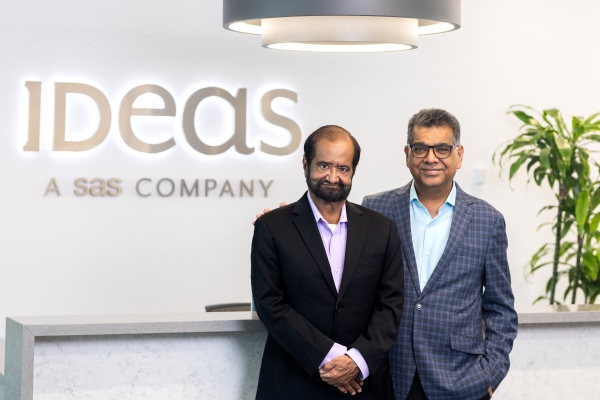
Ravi Mehrotra and Sanjay Nagalia founded IDeaS in 1989 after meeting on a train bound for university years prior. Photo credit: Belu Photography
BACK IN THE DAY
The practice of revenue management was still primitive in the 1970s and 1980s, governed by analog systems and gut instinct. This began to change in 1978 when the airlines were deregulated, which ended years of strict federal control over pricing. Airlines suddenly had more freedom to set their own fares and compete on price. It wasn’t that simple: Merely lowering fares to fill planes could result in selling too many seats cheaply and having nothing left for passengers willing to pay more closer to departure. New methods were needed in a practice ripe for elevation and experimentation.
In 1989, Mehrotra and Nagalia launched IDeaS, a fanciful and fortuitous acronym for Integrated Decisions and Systems. Despite similar educational pedigrees, the two are more different than alike, according to Nagalia, but as scientists with electrical engineering backgrounds, they think similarly, which allows them to solve similar sets of problems. “We complement each other,” Nagalia said.
As Nagalia recalls, the startup was indeterminate at the jump, but the rationale was not: create a business that concentrated on the field of decision systems.
That direction was logical. As a professor at North Carolina State University, Mehrotra studied forecasting, optimization and decision-making under uncertainty. In short, how to make the best possible decision when the future is unpredictable. “There was no concept of forecasting; there was no concept of understanding demand as a function of price and trying to optimize,” Mehrotra said of the early days of revenue management.
It was in those early days that IDeaS pioneered an approach called “Opportunity Cost,” which dealt with length-of-stay effects. This meant that a hotel, for instance, needed to consider not simply the price of a room, but how long that room was being booked for and displacement, which is the acceptance of a lower-yielding reservation (business on the books) that prevents the hotel from selling those same rooms later at a higher-yielding rate. Other ideas IDeaS championed included hurdle rates and last room value or what a hotel would expect to sell its last room at based upon demand and price sensitivity.
It was radical, and much of it became the basis for modern-day hotel revenue management. As it happened, airlines, not hotels, were where IDeaS got its first shot. Northwest Airlines was a thriving U.S. carrier prior to its merger with Delta in 2010. Twenty years before, it approached IDeaS to create a network optimizer for airline revenue management. The idea was simple if its implementation was less so: airlines shouldn’t optimize each flight or seat independently.
Consider a flight from Minneapolis to Tokyo. One passenger occupies a seat on the flight, but the economics of that seat depend on the entire flight network. Another passenger might want the same seat but is traveling from Minneapolis to Detroit. Yet another traveler might be connecting onward to Tokyo. The question becomes: What’s the economic value of keeping the seat available for a potentially higher-value itinerary rather than selling it now? Applying IDeaS’ Opportunity Cost postulate and it becomes clear: A seat isn’t worth what the next passenger will pay for it; it’s worth what you might lose by giving it to that passenger instead of someone else. Leg-based optimization was conceived.
To this day, Delta uses some version of a solution IDeaS designed years ago.
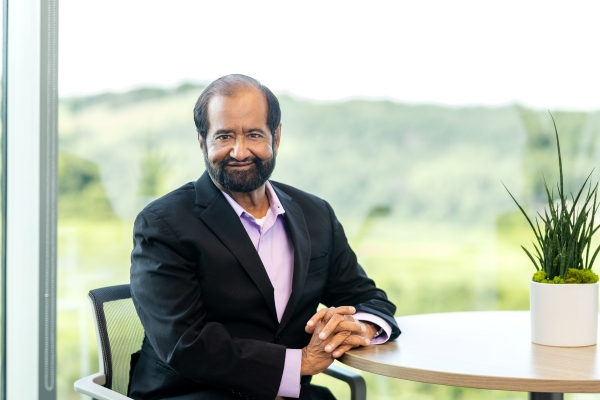
Ravi Mehrotra, president, co-founder and chief scientist, IDeaS
CHANNELING HOTELS
Many of IDeaS’ airline applications are relevant to the hotel industry because, as Nagalia observes, both products are similar. “You have fixed capacity, different types of paying customers and inconsistent demand,” he said. “When you have a combination of these things, there’s opportunity to give different people different prices and for different products based on their willingness to buy.” As Nagalia recalls, the biggest challenge facing IDeaS at the outset was resistance. “It was making them realize that they were leaving money on the table,” he said.
Northwest Airlines was a bridge to hotels and built on a similar concept: perishable inventory. A hotel has a fixed number of rooms and once a room isn’t sold, it disappears forever. “Revenue management has always been about making better decisions under uncertainty,” said Mehrotra. “The goal was never higher prices. The goal was to match the right customer with the right product at the right time and at the right price. What mattered was making the best possible decision based on the information available.”
On the leadership page of IDeaS’ website, there is a picture of Mehrotra. He’s holding what appears to be a wooden block with the inscription: “Imagination Will Take You Everywhere.” It’s the kind of bromide one might pass off as trifling, but for Mehrotra, it’s material. On that same page, Mehrotra’s bio characterizes him as “Einstein-inspired.” For anyone who has spent time with him, it’s spot on. Like Einstein, Mehrotra challenges assumptions. And while both were and are certainly brilliant, one of their biggest gifts was not just mastery of science and numbers, but the ability to reduce the esoteric to the comprehensible.
“I view my job not as, ‘I have to provide a solution,’ but, rather, ‘I have to provide a means for further success,’” Mehrotra said. And like a teacher, he boils room pricing down to its core. “You start with high prices only to realize that the demand you anticipated didn’t flow up,” he said. Now, you are left with empty rooms (perishable inventory, remember) and will forcibly take every booking that comes along. “Conversely,” he said, “when you think you’re going to be empty, and you sell rooms very cheaply, and the hotel fills up.” Then, you are left with no wiggle room if you wanted to sell rooms to prospective guests willing to pay more for them. “[Hoteliers] don’t have to be rocket scientists. They don’t have to understand the laws of mathematics and physics to understand these unfavorable situations,” he said in true Mehrotra fashion. “That is how we were able to convince them to trust the technology.”
And like Einstein, there is a humanistic quality about Mehrotra that oftentimes makes him sound less like a scientist and more like a philosopher. Despite the successes, there is humility. “Pride goes before a fall,” he said when asked about milestones and achievements. “Our intent has always been how to introduce more rationality into the way we do things. It did not exist. Nobody thought that this would become a necessity where, without revenue management, the businesses would not be able to function the way they need to function.”

Sanjay Nagalia, co-founder, COO and technology officer, IDeaS
A BIG FISH
Hilton caught on. It became IDeaS’ first big hotel client back in the 1990s, well before it was a 9,000-plus-hotel behemoth. In fact, in those days, Hilton was two separate entities, a U.S arm and an international one. Chris Silcock, who is president of global brands and commercial services for Hilton, is retiring next year. He has fond memories of Hilton’s initial tie-in with IDeaS, like the time he and Mehrotra hammered out a deal in a small hotel room somewhere in Ithaca, N.Y.
Part of Silcock’s 30 years with Hilton included heading up revenue management. Back then, Silcock affectionately thought of Mehrotra as a sort of sane mad scientist. “He understood the hotel business so deeply and how to solve problems analytically,” he said. “What you don’t traditionally get with a mad scientist is the capability to make it understandable. I’ve never seen anything like it since. That’s what’s unique about him.”
The commendations don’t end there. Hyatt has been a customer of IDeaS for some time. Michael Klein, SVP of global revenue management at Hyatt, first met Mehrotra in the late 2000s when he was revenue managing hotels on the West Coast and Hawaii for Fairmont Hotels & Resorts. Back then, the tyro Klein saw revenue management through a prism of human intuition and art mixed with some math. He leaves no doubt of Mehrotra’s impact on his career. “Ravi helped me see that revenue management could be something even more rigorous: a science for making better decisions in the face of uncertainty,” he said. “He always approached the next idea with the mind of a scientist: Does it solve a real problem? Does the science hold up? Will it make the decision better? And will it create lasting value for the people who depend on it?”
It’s not hyperbole to say that Mehrotra and Nagalia never could have imagined that one day the world’s largest hotel companies would essentially outsource their most important commercial decisions to them. That is the faith Hilton had and still does. “Most systems were trying to build a recommendation system; we were looking for something different, which is exactly their belief: a decision system,” Silcock said.
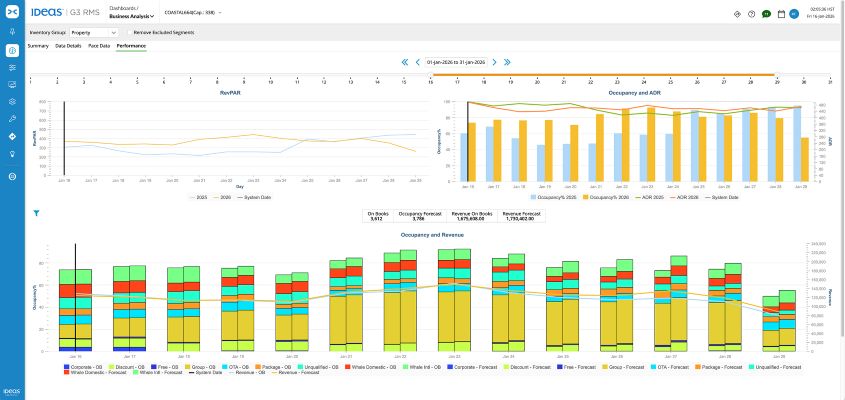 IDeaS’ G3 RMS analyzes real-time market data, competitor pricing, and historical trends to optimize room pricing, forecast demand, and maximize profitability.
HARDCODE TO AI
When Hilton first approached IDeaS, revenue management looked more Stone Age than Digital Age. Back then, the focus, even the goal, was around understanding what happened. Today, it’s about decision intelligence that influences all commercial aspects. Klaus Kohlmayr is chief evangelist and development officer for IDeaS. He’s been with the company for a combined 15 years. Years ago, he held property-level positions and painfully remembers the early days of revenue management when it wasn’t automated. “I had to make every pricing decision based on a huge Excel spreadsheet, using data that I manually imported. Then, whatever pricing guess I made had to be manually typed back into the selling systems,” he said. He first interacted with IDeaS at a hotel in 1998. The installation, he remembers, necessitated the purchase of a server and 30 floppy disks. But it was an inflection point. “Not only was the entire process automated, but it worked 24/7 and with a level of sophistication I could never achieve on my own,” he said. One big turning point was the shift to the cloud in 2003, which opened up a range of data sets hotel owners and operators could leverage.
IDeaS was acquired by data company SAS in 2008. Leadership didn’t change. The mission didn’t change. The only thing that did shift was IDeaS’ access to greater analytical power that has allowed it to accelerate innovation. A day doesn’t go by that Mehrotra isn’t queried about artificial intelligence and its impact on revenue management. It turns out, AI is not new to IDeaS. For decades, it’s employed machine learning, forecasting models and optimization techniques. “What’s changing today is not the existence of AI, but its accessibility,” Mehrotra said. Before ChatGPT and Claude became household names, sophisticated analytical systems required specialized expertise to interpret and apply. “Generative AI allows people to interact with those systems more naturally and intuitively,” he said. In his way, the pedagogic Mehrotra offers three degrees of AI: predictive, which posits what is likely to happen; optimization, which instructs what to do about it; and generative AI, which helps understand why. “When those three capabilities work together, we move beyond reporting and recommendations toward true decision intelligence,” Mehrotra said.
AND BEYOND
Framing IDeaS as a supplier of revenue management capabilities to the hotel industry is only part right. There is nuance: decision intelligence extends far beyond the reach of the hotel lobby. In recent years, IDeaS has ventured into complementary verticals, including cruises, working with lines like Virgin Voyages and Windstar Cruises. For years, IDeaS’ tools have been used in car parks, such as those found at Heathrow Airport in England and LaGuardia Airport in New York. It’s also beginning to dabble in events and adjacent experiences, like waterparks. To Nagalia, it represents the further acceptance and prominence of revenue management as an integral part of a commercial operation.
Mehrotra isn’t keen to talk legacy. Not yet at least, especially when his passion for the work is still as palpable as it was when he and Nagalia set IDeaS into motion 37 years ago. Legacy has a starting line: Over the course of more than three decades, IDeaS has shaped and molded modern-day revenue management, evolving it from hunch and instinct to a practice grounded in science and scholarship. The work doesn’t have a finish line.
For Mehrotra, humbleness, not hubris, wins the day. “One of the things science teaches is humility. Every breakthrough builds on the work of others, and every generation inherits ideas that it has a responsibility to advance,” he said. “If I’m remembered for anything, I hope it’s for helping establish a discipline that made better business decisions possible.”
The 11 Best Things to Do in Las Vegas (and Top Things to Avoid)

ALFSnaiper/iStock
https://www.fodors.com/world/north-america/usa/nevada/las-vegas/experiences/news/photos/best-things-to-do-in-las-vegas
The best things to see, eat, and do in the City of Sin.
I eagerly peeked out the window as my flight approached Harry Reid International Airport. Before even traveling there for the first time, I had the map of The Strip memorized. I could recite all the hotels and their corresponding themes like the back of my hand.
As a 23-year-old college student, I was a self-proclaimed Vegas lover, even though I didn’t gamble or drink. On that first trip, I walked through every single hotel on Las Vegas Boulevard. I also took my first helicopter ride over the city, Hoover Dam, and the Grand Canyon. I realized that a champagne brunch and a scenic flight don’t churn together if you are prone to motion sickness. I indulged in my first all-you-can-eat seafood buffet (only $25 at the time) and watched one of the iconic Vegas burlesque shows, only to be shocked to find the dancers topless! At night, I returned to the quiet suburbs to stay with my uncle and aunt, who took me to a neighborhood Italian restaurant where I was certain some of the guests were mafia members.
Over countless family reunions, I explored lesser-known eateries, hiked in the scenic Red Rock Canyon, and took long drives to surrounding national parks. As I revisited for work, I stayed at the opulent Fontainebleau, attended the first Southwest Michelin Guide ceremony (as of 2026, Las Vegas has got its Michelin Guide back), went behind the scenes to meet the cast of “O,” and ate at all the hottest new restaurants. Two decades and countless trips later, I still feel the same excitement every time I touch down in Vegas, for the promise of a new and thrilling adventure always remains.
These are my picks for the best things to do and see, plus the must-try restaurants, the top hotels for any budget, and a few things to avoid.

PHOTO: Sean Pavone/iStock
1 OF 22
The Sphere
WHERE: The Strip
The constantly changing LED-lit graphics on the 366-foot-tall Sphere entertainment venue against the city’s skyline are captivating from all angles, whether you are driving past or gazing from your hotel room window. The Sphere is awe-inspiring from the outside, but for an even more immersive experience, step inside to see a concert or a film.
Watching the reimagined 1939 Metro-Goldwyn-Mayer classic, “The Wizard of Oz,” makes for a great afternoon activity, offering stunning 16K optical and sensory 4D effects along with introspection about human impact on the planet and our future. Arrive early to explore the futuristic AI art installations in the atrium, and aim for mid-level seats (200-300 levels) for the absolute best wraparound perspective. Headlining live concerts are tied to limited residency dates, so plan your trip around the calendar. For the best balance of immersive visuals, direct line of sight, and optimal spatial audio, book a seat in the center of the 300 Level (Sections 305–307).
2 OF 22
Museum of Ice Cream
WHERE: AREA15
Now you can touch, taste, play, and photograph your way through the largest Museum of Ice Cream in the world. Spanning approximately 30,000 square feet and featuring 14 immersive installations, the whimsical museum is more of an interactive experience, centered on nostalgia and dessert, with music, lights, and participation.
The Las Vegas location features the world’s largest all-you-can-eat ice cream buffet, featuring rotating flavors and frozen treats from different brands. You will feel like a kid jumping into the world’s largest sprinkle pool, posing at a retro American diner serving milkshake-inspired installations, and posing at the Las Vegas-themed wedding chapel, complete with oversized ice cream props and neon signs that make for fun photos. Play a round of mini golf with candy-inspired obstacles, and use the pink subway car with oversized popsicles, banana swings, and giant scoops as a backdrop for fun photos with the family. The museum features interactive games, hidden surprises, and sensory elements designed for both adults and children.

PHOTO: COURTESY OF CAESARS ENTERTAINMENT
3 OF 22
Aescape Robotic Massage at Qua Baths and Spa
WHERE: Caesars Palace Las Vegas
If you’ve ever wondered what a massage by artificial intelligence feels like, book an Aescape session at Qua Baths and Spa inside Caesars Palace, the first resort on the Las Vegas Strip to introduce robotic massage therapy. Instead of slipping under a sheet, you’ll change into specially designed, form-fitting Aerwear, then lie face down while a 3D body scan maps your muscles and creates a personalized treatment. Two heated robotic arms glide over your body with remarkable precision, allowing you to adjust the pressure, target areas, music, and even lighting from a touchscreen at any point during the session. The fully automated experience allows you to personalize pressure and focus areas for a precision-driven massage.
It’s especially appealing if you’re touch-averse, prefer not to undress for a massage, or are simply curious about where wellness technology is headed. The Aescape session can be booked for 30-minute increments and costs a fraction of a regular massage treatment. Go on a weekday for discounted pricing and pair it with a day access to Roman soaking baths for a memorable wellness experience.

PHOTO: COURTESY OF EVEL KNIEVEL EXPERIENCE
4 OF 22
Evel Knievel Experience
WHERE: Las Vegas Arts District
The newest attraction at the Arts District brings back to life one of America’s original daredevils and celebrates the life, legacy, and larger-than-life persona of legendary American stunt rider and entertainer Evel Knievel.
Walk through immersive exhibits to see rare motorcycles, vintage jumpsuits, and the helmet from his infamous crash at Caesars Palace. A 4D virtual reality jump lets you experience one of his death-defying stunts from the rider’s perspective, while interactive displays reveal the grit, injuries, and showmanship behind his career. Even if you weren’t around for Knievel’s heyday, the museum offers a fascinating look at the man who turned fearless risk-taking into a uniquely American form of entertainment.

PHOTO: CRISTIAN LOURENÇO/ISTOCK
5 OF 22
Bellagio Conservatory and Botanical Gardens
WHERE: Bellagio Resort & Casino
No two visits to the Bellagio Conservatory and Botanical Gardens are the same, so this is a must-visit in Vegas to admire nature and art inside a temperature-regulated environment. It is completely free to visit and open to the public 24 hours a day, seven days a week (but check for “dark dates” closures when they are changing out the displays).
The 14,000-square-foot indoor Botanical Gardens completely transform five times a year with themed displays of scented floral arrangements, fairy-tale gazebos, intricately designed sculptures, and sensory music. It offers a beautiful backdrop for photos, especially when you are already dressed up for the evening.
INSIDER TIP:
Avoid dining at The Garden Table unless you don’t mind being part of the spectacle. Monitor the live feed to plan your visit and avoid large crowds.

PHOTO: ANTHONY MAIR / COURTESY OF MGM RESORTS
6 OF 22
Fountains of Bellagio
WHERE: Bellagio Resort & Casino
Even though the fountains have been captivating crowds for nearly three decades, the Fountains of Bellagio spectacle never gets old. Strolling along the Strip after dark, you’ll be enchanted as over a thousand water jets sway in unison, dancing to tunes ranging from Frank Sinatra to modern pop, enhanced by fully synchronized lights. As you feel the light mist from the water spanning 1,000 feet across the lake and soaring up to 460 feet in the air, the show feels larger than life.
Because the music and choreography change with every single performance, it is worth staying to watch a few back-to-back. The fountains erupt every 30 minutes during the afternoon (starting at 3 PM on weekdays, noon on weekends) and every 15 minutes at night until midnight. It is completely free to watch and fun for all ages.

PHOTO: ©CAESARS ENTERTAINMENT/MICHAEL RUDIN - UNLIMITED IN PERPETUITY
7 OF 22
Big Martha’s Pierogies Class at The Bedford by Martha Stewart
WHERE: Paris Las Vegas
Skip another celebrity-chef dinner reservation and roll up your sleeves instead. One of Las Vegas’ newest culinary experiences, Big Martha’s Pierogies Cooking Class at The Bedford by Martha Stewart, lets you knead, roll, fill, and crimp the restaurant’s signature potato pierogies alongside the executive chef.
You will learn to make the original recipe that comes from Martha Stewart’s Polish-American mother, affectionately known as “Big Martha,” whose homemade dumplings inspired one of the restaurant’s most beloved dishes. While Stewart occasionally drops in for surprise appearances, they’re rare enough that you shouldn’t book expecting to meet her.
After class, reserve Martha’s Personal Table at The Bedford’s Brown Room, an exact recreation of the dining room in Stewart’s Bedford, New York farmhouse. Between the family stories, hands-on cooking, and intimate setting, the experience feels less like another celebrity restaurant on the Strip and more like spending an afternoon cooking in Martha’s own home.

PHOTO: MICHAEL POTTS F1/SHUTTERSTOCK
8 OF 22
Grand Prix Plaza
WHERE: Las Vegas Strip
Part museum, part high-tech arcade, and part theme park, Grand Prix Plaza is the world’s largest immersive Formula 1 fan experience. Located at the permanent Pit Building, it offers you a chance to dive into motorsport history, explore cutting-edge automotive technology, and put your driving skills to the test. A highlight of the visit is suiting up for F1 DRIVE, where you can get behind the wheel of high-performance karts and race family or friends along a modified section of the actual Las Vegas Strip Circuit.
Inside the 100,000-square-foot facility, you can explore interactive 4D exhibits, design your own virtual F1 car and race helmet, take on full-motion driving simulators, and recharge at the onsite F1 HUB Lounge. On race weekends, fans can join watch parties, meet drivers, and participate in family-friendly fan celebrations. The main race lights out on Saturday at 8:00 p.m. PST and lasts roughly 90 to 120 minutes. Plus, with Formula 1 committing to a long-term contract extension, the Las Vegas Grand Prix is locked in to stay on the F1 calendar through at least 2037. Note that F1 DRIVE is hands-on kart racing on the actual circuit that lasts 12-30 minutes, while F1 X is an interactive museum and 4D exhibition that takes about an hour to visit. Purchase bundled tickets to experience both.

PHOTO: KIT LEONG/SHUTTERSTOCK
9 OF 22
Downtown Container Park
WHERE: Downtown Las Vegas
The industrial-looking Downtown Container Park may appear strange and out of place at first sight, but it is one of the coolest places to enjoy live music and daytime wandering off the Strip. The 1.1-acre, open-air shopping center and entertainment venue features 39 shops, restaurants, and bars–all constructed of 43 repurposed shipping containers and 41 locally manufactured Xtreme cubes that are works of art themselves. Make sure to check out the giant metal praying mantis–she shoots out flames after dark! You can even take the kids to blow out the steam at The Treehouse and The Lawn at Container Park. There are tons of kid-friendly activities like balloon artists, face painters, and free movies on weekends. Only adults are permitted at the Park after 10 p.m.

10 OF 22
'O' by Cirque du Soleil
WHERE: Bellagio Resort & Casino
If you are a fan of Cirque du Soleil, “O” will take your imagination to a new dimension! Permanently housed in a dramatic opera house-style theater, the aquatic stage, holding 1.5 million gallons of water, is the only entirely water-based performance by the world-renowned Canadian nouveau cirque. Watch former Olympic swimmers, professional scuba divers, and acrobats execute high-flying stunts and plunge into a giant pool with incredible artistic grace.
This is one show where it is worth splurging on the “La Grande Expérience” package. You’ll skip the main lines and be whisked off to an exclusive VIP lounge to sip champagne, chat with cast members, and take photos. You’ll also watch a guided video presentation revealing the stage’s intricate engineering secrets before enjoying the performance from a private, luxurious VIP suite.
How hotel revenue managers solve for uncertainty amid AI challenges and inconsistent booking windows
Profitability becomes guiding light for hoteliers

(Getty Images)
https://www.costar.com/article/1963027458/how-hotel-revenue-managers-solve-for-uncertainty-amid-ai-challenges-and-inconsistent-booking-windows?
NASHVILLE, Tennessee — The hotel industry was marred by recurring uncertainties last year. But just because the tides have turned to more positive performance in 2026, the uncertainties have not all dissipated.
Artificial intelligence adoption, distribution channels, and booking windows are examples of areas where revenue managers are trying to maximize performance and profits at their hotels.

AI, technology
As a relatively smaller company, it's been a challenge for Milwaukee-based Marcus Hotels & Resorts to parse out how it can utilize AI compared to larger companies and brands that have more resources, said Linda Gulrajani, the company's vice president of revenue strategy and distribution. Marcus manages 17 branded and independent hotels and has ownership interests in seven.
"How does AI impact independent hotels? How do we invest in the right tech stack to get prepared for AI? How do we divide our resources to deploy against AI? Because it's not free and it takes time to learn and it takes the right people," she said during a revenue management roundtable hosted by CoStar News Hotels at the recent Hotel Data Conference.
Smaller hotel companies have had to figure out how to implement AI on the fly. Lynsey Kreitzer, executive vice president of commercial strategy at New Hampshire-based operator Lark Hotels, said her company is "creating our own roadmap" when it comes to AI.
Lark operates 60 hotels and has ownership in 19, all independent.
That roadmap includes choosing the right partners to give Lark an edge over its competitors, she said. It's not just AI, though; it's building out a tech stack as a whole.
"It's got to be the right fit. It's got to drive direct business," Kreitzer said.
A big unknown is which distribution channel is the most optimal as travelers book more with AI tools, Gulrajani said. Brands and online travel agencies are vying for the top spot, but the choice isn't clear, yet.
"You're already starting to see ads on different AI tools, and it's kind of a little bit like the wild, wild West to me," she said.
The advent of AI tools has brought more data points than ever to the table. Sorting through that data and charting a strategy based on the insights is something revenue managers are in the process of figuring out, said Allison Frazier, vice president of revenue management at Atlanta-based private equity firm Peachtree Group. Peachtree owns 127 hotels and manages 130, all branded.
"It is about how to be efficient and how ... do you take all of this data, make it actionable and useful to actually setting strategies, actually understanding what's going on versus I've got all these reports," she said. "Hopefully that's where AI should be able to help us."
Keeping up with shifting booking windows
Booking windows across most segments are shorter than they were pre-pandemic, a shift that is constantly changing and keeping hotel revenue managers on their toes.
This change has empowered revenue managers to embrace flexibility in their strategies, Frazier said.
"The mix of business has shifted, the booking patterns have changed and continue to sometimes change," she said.
"We've shifted a little bit more, too," she said, in that the company's commercial teams talk a lot more about profitability than they used to.
Rather than just pushing for the highest average daily rate, hotel commercial teams down the line understand the cost of acquisition and distribution costs, she said. Sometimes if the cost to acquire business is too high, it's not worth the high rates they bring in.
It comes down to "really understanding your profitability and how, from a revenue team, we impact that by managing our channels, by managing our segmentation, and just making that be more of a culture within the company of how we train people, how we talk to people, what questions we ask," Frazier said.
Kreitzer said booking windows today depend on the traveler. More high-intent travelers are booking several trips at a time months in advance, but midweek travel is lagging behind and "very last minute" in nature.
An adjustment to this for hotel revenue managers has been keeping midweek rates higher for longer.
"We're just trying to capture what's there," Kreitzer said. "That shift in mindset for the midweek — dropping a rate isn't creating demand."
DUHC&S | Strategic Hospitality Consulting & Advisory
We transform hospitality and tourism businesses through strategic solutions, operational efficiency, and comprehensive renovation. With over 40 years of experience working with brands like Hilton, Hyatt, Sheraton, and Sonesta, we enhance asset value and profitability through:
• Business reengineering and renovation
• Operational excellence and brand standards (GSI +90%)
• Market penetration and commercial strategies
• Key partnerships and disruptive innovation
• Hotel openings and repositioning
Proven results:
✅ 48% GOP
✅ +120% asset valuation growth
✅ Successful projects across 6 Latin American countries
👇 To read the full analysis and connect with us, please check the link in the first comment.
🔹 Let's connect with DUHC&S:
👉 https://linktr.ee/diurugeles
📩 Email: diurugeles@gmail.com
📱 WhatsApp: +57 3153259968
🌐 Access our full blog analysis, YouTube channel, LinkedIn, and social media through a single link.
#DUHC&S #HospitalityConsulting #OperationalExcellence #Hotels #BusinessTransformation ---
Disclaimer:
DUHC&S shares this information for educational and informational purposes only. The news articles reproduced here are sourced from public and recognized media outlets. We are not the original authors of this content but rather its distributors. All credit goes to the original sources cited in each article. If you are the legitimate owner of any material and wish to have it modified or removed, please contact us immediately at diurugeles@gmail.com, and we will address your request promptly.


Comments
Post a Comment