Generative AI can change real estate, but the industry must change to reap the benefits
Generative AI can change real estate, but the industry must change to reap the benefits

https://www.mckinsey.com/industries/real-estate/our-insights/generative-ai-can-change-real-estate-but-the-industry-must-change-to-reap-the-benefits?
By
Real estate can use generative AI to turn the industry’s data into treasure in seven steps
Generative AI (gen AI) is maturing at an auspicious moment for the real estate industry. Investors have mountains of both proprietary and third-party data about properties, communities, tenants, and the market itself. This information can be used to customize existing gen AI tools so that they can perform real estate–specific tasks, such as identifying opportunities for investors at lightning speed, revolutionizing building and interior design, creating marketing materials, and facilitating customer journeys while opening up new revenue streams.
Although gen AI has only recently captured the public’s imagination, AI has been fundamentally changing the way the world does business for decades. This more familiar version of AI—also known as analytical AI—is goal oriented and focused on activities such as predicting values for a future forecast or assigning categories to segment customers. It is already embedded in parts of the business world: AI-assisted forecasts, for example, have altered how investment professionals think about the future, and dynamic pricing models have changed how several industries charge for goods and services. One industry in which AI’s transformative power has been missing, however, is real estate, a historically slow adopter of new technologies.
Gen AI represents a fresh chance for the real estate industry to learn from its past and transform itself into an industry at technology’s cutting edge. Gen AI has not replaced analytical AI; instead, its open-ended and creative nature introduces a new frontier of use cases that analytical AI does not address. Based on work by the McKinsey Global Institute (MGI), we believe that gen AI could generate $110 billion to $180 billion or more in value for the real estate industry.
For all the hype that gen AI has received to date, many real estate organizations are finding it difficult to implement and scale use cases, and thus have not yet seen the promised value creation. This is not surprising: deriving competitive advantage from gen AI is not as simple as just deploying one of the major foundational models, and many things have to go right in an organization to make the most of the opportunity. To help companies get started, this article will explore the technology’s potential and provide examples of use cases, each of which real estate actors we work with are in some phase of exploring or implementing. The article will then describe seven pivotal, interconnected actions that real estate companies can take to realize the full value of this gen AI–fueled vision and create strategic distance from their peers.
Gen AI represents a fresh chance for the real estate industry to learn from its past and transform itself into an industry at technology’s cutting edge.
Real estate can benefit from gen AI in a multitude of use cases
Gen AI’s strengths generally fall within one of four categories, which we dub “the four Cs.” The first is customer engagement, which can be supported by tools such as conversational chatbots that answer questions and remove doubt from customer decisions. The second is creation, in the form of tools that generate new creative content, including text and images. The third is concision: gen AI excels at synthesizing insights from unstructured data, interpreting conversations, and querying large data sources. The fourth is coding solutions, of which Gen AI offers many, including interpreting, translating, and generating code.
In our own work with AI, we have seen real estate companies gain over 10 percent or more in net operating income through more efficient operating models, stronger customer experience, tenant retention, new revenue streams, and smarter asset selection. Here are five examples of how businesses can apply Gen AI’s four Cs to specific real estate issues.
In our own work with AI, we have seen real estate companies gain over 10 percent or more in net operating income through more efficient operating models, stronger customer experience, tenant retention, new revenue streams, and smarter asset selection.
Sifting through mountains of leasing documentation (concision)
Gen AI can be applied to a repository of lease documents, which can be dense and filled with bespoke terminology, making it difficult for owners of many properties to sift through and find information at scale. A gen AI–powered tool can summarize key themes across the leases, such as how much rent is expected monthly or what market forces (such as local environmental, social, and governance compliance laws) could affect leases. Additionally, the tool can scan across leases for a particular parameter (for example, all leases with a rent price per square foot below a certain level) and generate tables of information. At that point, professionals can examine the information the AI tool has compiled.
Copiloting real estate interactions (concision and customer engagement)
Gen AI can be used to create a powerful copilot (a gen AI–powered bot) for a variety of real estate interactions, including managing tenant requests and lease negotiation. Simple requests from tenants, such as for routine maintenance, can prompt the copilot to directly contact a building’s maintenance staff. The copilot can identify a more complex question and flag it for a specialist at a property management company. As the specialist interacts with tenants, gen AI can observe conversations and written responses and suggest ways to improve communication. For high-stakes moments—such as a commercial lease negotiation with an office, warehouse, or retail tenant—a gen AI tool can take in all the information about a tenant, the property, and the market and craft a negotiation transcript. If communications and calls are recorded or turned to text, the copilot can monitor these interactions at scale, providing coaching while reminding specialists to refrain from using certain terms that could incite moments of risk.
Enabling visualization and creating new revenue streams (creation and customer engagement)
Today, when a prospective office tenant looks at raw space on a tour or a potential resident views pictures of an apartment on a listing site, they see an empty unit or photos filled with someone else’s finishes and furniture. Virtual reality tours have helped, but these static, noncustomizable simulations usually only go part of the way toward showing the end user what the result could be.
Gen AI tools can help a potential tenant visualize exactly what an apartment would look like in, say, their preferred midcentury modern style or in cherrywood versus walnut finishes. This data can then be fed back into a model to predict which types of furnishings and finishes work best for different customer segments, improving prospect-to-lease conversion and shaping future capital expenditure decisions.
There can also be e-commerce tie-ins: as a prospective tenant tours a unit, an app can virtually impose a variety of couches, window trims, or kitchen appliances that match a desired design style. If the prospective resident decides to buy or lease, these choices can be ordered and set up to coincide with the move-in. The resident benefits by moving into a home that already expresses their signature style, and the brokerage or apartment company benefits by reaping revenue from cross-selling.
One large furniture retailer has launched a gen AI–powered product visualization tool that enables users to upload a photo of a room and populate it with furniture from its catalog. A variety of businesses throughout the value chain can use this capability to create new revenue streams while deepening customer loyalty.
Making faster, more precise investment decisions (concision)
Today, investment decisions are often informed through individual analysis of bespoke data pulls across sources. An investor interested in warehouses, for example, typically starts by performing a macroanalysis of markets that have attractive factors such as ports, airport locations, and high e-commerce volume. Then, they perform more granular analysis to locate areas of interest, pulling building information from local brokers or digital tools. As part of the decision-making process, the investor conducts discrete analyses to figure out how their investment hypotheses have panned out in the past.
With a gen AI tool that’s fine-tuned using internal and third-party data, an investor can simply ask, “What are the top 25 warehouse properties up for sale that I should invest in?” or, “Which malls are most likely to thrive in the future?” The tool can sort through the unstructured data—both internal (such as the performance of a company’s existing properties and the lease terms related to this performance) and third-party (such as the US Census and publicly recorded, comparable sales). This multifaceted analysis can be overlaid on a list of properties for sale to identify and prioritize specific assets that are worth manual investigation.
Drawing architectural plans known to create desired outcomes (creation)
In website design, there are specific patterns and design choices known to generate e-commerce sales or higher click-through. Similarly, there are underlying design principles in the physical world that gen AI can unlock and use to draw architectural plans.
A gen AI–assisted process can introduce Internet of Things sensors and computer vision algorithms that collect data points on space use, such as how customers move through a store before purchase or when conference rooms are used in an office. This insight—along with outcome data about sales, customer loyalty, productivity, employee retention, or other areas—can then be fed to a gen AI tool. This information can be overlaid with spatial data about square footage, location, walls, furniture, and other architectural elements. The gen AI tool can then develop architectural plans that are optimized to create desired outcomes in a space. Human architects and designers can work from these plans to ensure art and emotion in the design, but with less guesswork over whether a space is purpose-driven (illustration).

Illustration of gen AI–assisted architectural designs that show where daylight would fall on this design, how the plan would accommodate typical foot traffic patterns, and whether noise levels would distract people in the space.
Source: McKinsey research and experience with sensor and computer vision data
""
Seven pivotal actions real estate players can take to realize the full value of gen AI
Gen AI holds the promise of transformation, but real estate companies will have to do more than just learn how to use off-the-shelf products. Although foundational models are essential, they are just a small component of a real estate firm’s ability to realize value from gen AI.
To seize the opportunity, businesses in the real estate value chain can strive to outcompete by rewiring the way they work in the following ways.
Although foundational models are essential, they are just a small component of a real estate firm’s ability to realize value from gen AI.
Align the C-suite around a business-led road map tied to a specific part of the real estate value chain
CEOs who want to lead in gen AI can prioritize technology, onboard new internal capabilities, and organize for agile delivery just as top start-ups and tech-native companies do. New ways of delivering technology are essential not just to gen AI delivery but also to ensuring modernity and staying ahead of the strategic curve. Winners are willing to experiment, iterate, and self-disrupt.
That starts with having capabilities that go beyond the traditional real estate IT organization. This does not mean leaders have to welcome scores of new tech hires into their companies. Rather, it requires investing in a nimble squad of engineers and designers who are familiar with gen AI and can be directed to focus exclusively on value-adding use cases.
C-suites can start by assessing which part of the real estate value chain they occupy—such as development, operations, or investment—and considering how the journeys of tenants, employees, and other stakeholders can be reinvented. Then, they can begin redesigning roles and structures to make the alignment happen. Getting value from gen AI requires that executives be willing to question the industry’s traditional hierarchies and operating models and, most importantly, to accept a new technology layer throughout the organization. Gen AI requires executive-led adoption of new ways of working that will elevate the power of professionals across functions and levels.
Adopt a laser focus on data—especially new proprietary data
In the gen AI future, those with access to and control over unique, informative data will be able to generate insights that others cannot. Companies can start by thinking about what data they need—as well as what proprietary data about tenants and properties is available but not currently being collected.
It is essential not only to have the best data set but also to have it engineered the right way with the right data governance. A conversational AI tool that has been trained on a building’s past maintenance requests can efficiently respond to resident complaints. A tool trained on a real estate portfolio’s net-operating-income data can provide answers about performance that could be useful for investment decisions and for reporting to investors and internal company divisions. Internet of Things sensors and computer vision applications in office buildings, for example, can provide anonymized insights into how tenants use spaces, creating nuanced views of the built environment. Tenant apps and dashboards are not merely interaction channels; they themselves can become data sources. What kind of amenity space a residential tenant books, what stores a shopper in a mall browses, or what services an office tenant needs to produce an event are all valuable pieces of data that can be harnessed and structured.
It is important that this harnessing and structuring occur in a data lakehouse controlled by the real estate firm (as opposed to by a third-party system). A variety of vendors should be able to interact with this single source of truth. This will allow real estate firms to cut data by building, tenant, or type of unit or space for their own internal uses and to be flexible enough to switch systems and applications easily. Companies should be conscious of data ownership and should make the ability to easily access and work with data a key part of vendor decision-making as they design their future tech stacks.
Engineer a prompt library that gets results from foundational models in a real estate context
Foundational gen AI models are only as good as the questions (known as “prompts”) asked of them. As models are fine-tuned with data specific to real estate, it’s important to engineer a prompt library.
A prompt could say, for example, “Use the following resident history and property data to craft an initial outreach email to a resident looking to renew their lease,” followed by, “Generate a follow-up email based on their response and consider offering one of the following more-personalized concessions based on what you know about the resident: waived pet fee for two months, complimentary deep carpet cleaning, or membership to the building’s gym for six months.”
Slight edits in syntax, detail, or framing can yield meaningfully different outputs with an impact that can only be discovered in action. There is no precedent for knowing what works until it is tried. To create a playbook, a rigorous process of testing and refining to ensure questions return expected answers is essential.
Create digital tools that promote action—not just insight
Newly popular large language models fascinate the public because of how easy it can be to write prompts and receive a comprehensible response. But real estate firms should not be lulled into thinking that all gen AI outputs are intuitive or that plug-and-play point solutions deliver the full promise of gen AI. Instead, outputs often need another layer of digital tooling to be useful to an organization.
A foundational model, for example, may generate marketing copy, but it may require additional tooling to check it for grammar and brand compliance and ensure the language abides by regulations. A gen AI model may come up with insights on how customer service should be delivered by a real estate agent, but agents may need to receive prompts in a specific cadence during client interactions or explanations that clarify why a particular recommendation is important.
Design is another crucial component. Color, style, and physical-design patterns for how a user clicks are paramount in traditional apps. With a gen AI interface, it could be more important to fine-tune a conversational system’s writing style or to make sure the customer-facing avatar and its spoken tone and pitch are agreeable to the audience and encourage desired behaviors. In short, the definition of design will have to expand as a new playing field of psychology tied to interactions with algorithms and machines emerges.
A self-service portal that makes it easy for employees to access company-approved tools and learn how to use them can enable organization-wide innovation.
Invest in a modern technology stack to enable data use
A vital leg of the gen AI stool is the tech stack: the right infrastructure, feedback loops, safeguards, and integration should be built in a secure, scalable, and user-friendly way.
Gen AI requires new capabilities relative to traditional AI and machine learning, including toxicity checks (ensuring gen AI is not creating problematic content, such as words or statements that would violate relevant fair-housing or antidiscrimination laws) and guardrails against hallucination (preventing gen AI from providing false answers without sharing that the tool is uncertain). Compared with traditional data science and analytics, gen AI relies more on engineering unique tech stack elements to make it effectively operational—capabilities that real estate businesses may lack in their current IT organizations.
Real estate companies across the value chain that embrace early proofs of concept and start orienting their tech stacks in the right direction to enable use cases in the future will be in the best position to benefit. Fruitful actions include taking the time to thoughtfully link vendor systems and connect the dots on data across property management systems, customer relationship management, and maintenance portals.
Adopt a new operating model that can scale as a real estate portfolio grows and diversifies
To enable a gen AI upgrade to processes for investing, leasing, and more, operating models and jobs may need to be redrawn to match the new focus points of work.
New roles and capabilities, such as prompt and data engineers who can implement foundational models, may be needed. People in existing roles, such as agents or on-site staff, may be able to hand off time-consuming tasks to gen AI tools, allowing them to focus on specialized tasks. In other cases, such as on marketing and investing teams, gen AI may evolve the discipline and create demand for new roles and skill sets. Companies need to be open to change because the face of the IT or marketing organization will not look the same with AI tooling, even if the objectives of the business unit remain the same.
Recognize and mitigate risks unique to real estate created by gen AI
Gen AI is new, maturing, and facing open questions. There may be biases in training data that are unintentional but create outputs with real consequences. There may also be questions about the intellectual properties feeding foundational models as the legal precedent around the space evolves. Marketing content, for example, may emerge from an algorithm trained on unlicensed images, catching the real estate business unawares. Provider tweaks to the foundational model that underpins a real estate–specific tool could create unforeseen consequences for output quality and content, making it important to reengineer prompts.
Additionally, some use cases may not be right for gen AI in its current stage. These might include emergency response, where the stakes are too high, or leasing decisions, where it could be difficult to comply with regulations that require explanation.
Deploying gen AI in situations where investment professionals, operating teams, and tenants meet introduces new risks to working, living, and shopping environments that have to be weighed. Companies that identify risks early on and iterate to find improvements will be positioned to react effectively.
We believe that the time is right for real estate to make the leap to gen AI for two primary reasons: first, the technology has now caught up to the problems that real estate companies face and, when properly designed and executed, can provide game-changing solutions. And second, commercial real estate today faces headwinds, and these new challenges demand innovative approaches. Gen AI will not replace analytical AI—there are use cases (such as producing a rent forecast or a retention prediction) for which more traditional machine learning excels. Rather, gen AI is opening up use cases that were never before possible and are relevant to dimensions of the real estate value chain that technology did not previously touch.
But can an industry that is a reputed tech laggard overcome structural challenges, invest in underlying technology, restructure operating models, and emerge as a gen AI leader? The fact that real estate has been a laggard may actually be an advantage, because the industry did not overinvest in previously available but now-outdated technology as some other industries did. The learning curve may be steeper for those who have not yet invested in technology and data strategies, but we believe Gen AI’s insights, speed, and transformational power for the real estate industry are worth the climb. Data—and use of that data to create strategic distance—are the new terrain on which businesses will compete for investor dollars, tenants, buyers, and longevity.
Data—and use of that data to create strategic distance—are the new terrain on which businesses will compete for investor dollars, tenants, buyers, and longevity.
The idea of getting started can be daunting, but we urge executives to start simply. Our technology professionals advocate for a “2x2” approach: identify two use cases that can launch a company into taking ownership of data, deliver measurable impact quickly, and build excitement; and identify two use cases that are more aspirational, will fundamentally change the business, and take more time to deliver. This approach encourages companies to push the technology toward its full potential.
There is no question that the real estate industry is changing. The question is which companies will answer that call of change, adapt, and embrace a new, digitally powered future.
10 Old-School Diners and Soda Shops That Still Serve a Perfect Slice of Americana

Sabrina Janelle Gordon/Shutterstock
https://www.fodors.com/world/north-america/usa/experiences/news/photos/the-best-classic-soda-shops-and-diners-across-the-usa
These classic joints are serving up nostalgia.
Heaping platefuls of homestyle comfort food, blinking neon lights, bottomless coffee, and apple pie under glass domes: few places feel more American than the diner. These beloved institutions trace their roots to 1872, when Walter Scott is widely credited with opening the first known horse-drawn lunch wagon in Providence, feeding late-night workers and kicking off a national trend.
By the early 20th century, New Jersey had become diner ground zero, where manufacturers like Jerry O’Mahony, Inc. transformed the humble lunch wagon into sleek, modern eateries modeled after train cars. Prefabricated and shipped across the country, they seemed to appear overnight. At the same time, soda fountains and drugstore counters were whipping up phosphates, malts, sundaes, and egg creams, drawing sweethearts, packs of friends, and late-night dreamers.
Their heyday may have faded, but some remain, dishing up a delicious slice of Americana. Here are some of the finest.

PHOTO: arlutz73/iStock
1 OF 10
Summit Diner
WHERE: Summit, New Jersey
There aren’t many surviving O’Mahony originals, but you’ll find one with this vintage chrome-and-comfort landmark, occupying a 1939 dining car, though the diner’s roots stretch back to the late 1920s. Inside, it still rocks its barrel roof, checkered floor, mahogany paneling, and snug 50-seat charm. There’s no menu here—the short lineup is posted above the griddle: juicy burgers, stacks of pancakes, and Taylor ham and cheese sandwiches, and endless cups of coffee. Recently awarded a major preservation grant from the National Trust for Historic Preservation and American Express, this Jersey classic promises to sizzle—in the best, greasiest way—for decades to come.
2 OF 10
Palace Diner
WHERE: Biddeford, Maine
This tiny railcar beauty, dating back to 1927, is often touted as Maine’s oldest diner. Slide into the gleaming 1920s interior, perch yourself at one of the 15 counter seats, and order what pilgrims come for: the legendary fried chicken sandwich on a sesame bun, served with cabbage slaw, mayo, Tabasco, and fresh jalapeño; if that doesn’t do it for you, the buttermilk flapjacks are a worthy rival. Legend says the sandwich was born from leftover chicken breasts once served at the diner’s fried chicken suppers. Modern acclaim followed when its chefs were named James Beard Awards semifinalists in 2020.

PHOTO: Nick Sherman[CC BY-NC-SA 2.0]/Flickr
3 OF 10
Lexington Candy Shop
WHERE: New York, New York
Lexington Candy Shop proves that not every classic New York diner comes wrapped in chrome. This Upper East Side institution is technically a luncheonette—the diner’s smaller cousin—built around a soda fountain, counter stools, and quick NYC comfort food rather than a traditional railcar and sprawling menu. Greek immigrant Soterios Philis opened the shop in 1925, and when it became a luncheonette in 1948, time practically stood still. Today, the third-generation Philis family still runs the place (with a business partner added almost 40 years ago). Order a Coca-Cola the old-fashioned way: hand-mixed with syrup and seltzer—or go bigger with a Coke float. Pancakes, eggs, and sandwiches abound, but the Lexington Special steals the show: a double-decker stack of roast beef, bacon, melted American cheese, and fried egg, with butter and Russian dressing. And no, none of this is the healthy option.

PHOTO: Thomas Hawk[CC BY-NC 2.0]/Flickr
4 OF 10
Town Topic
WHERE: Kansas City, Missouri
The story goes that Elizabeth Taylor loved Town Topic’s chili so much that she once sent an assistant to fetch a bowl as she waited in her private plane at the airport—a fitting tribute to one of Kansas City’s great culinary institutions. It all started when, in 1937, two former White Castle employees opened a tiny downtown stand, slinging smash-pattied burgers for five cents apiece, 24 hours a day—and offering other classic items as well, including pork tenderloin and ham and cheese sandwiches, shakes, malts, floats, and some of the best pies around. Town Topic soon grew to seven city locations, and its original spirit still sizzles on today.
5 OF 10
Zaharakos Ice Cream Parlour and Museum
WHERE: Columbus, Indiana
In a town celebrated for its modernist architecture, the Victorian-era Zaharakos has been a Columbus landmark for more than a century. Tiffany-style lamps, gleaming marble counters, and a rare 1908 Welte orchestrion time-travel you back to the early 1900s, when three Greek brothers opened the shop. The generous menu still serves up soups, salads, sandwiches, sodas, and treats made with homemade ice cream, but regulars know to order the Gom sandwich (its version of a Sloppy Joe) and a frothy orangeade.

PHOTO: ann-dabney[CC BY-ND 2.0]/Flickr
6 OF 10
Crown Candy Kitchen
WHERE: St. Louis, Missouri
Crown Candy Kitchen has been dealing in sugar highs since 1913, when two friends from the Balkan region—Harry Karandzieff and Pete Jugaloff—turned their confectionery know-how into a local institution. More than a century later, this old-school soda fountain, candy shop, and lunch counter is still family-run by Harry’s descendants. Inside, sparkling marble counters, vintage Coca-Cola signs, and weathered wooden booths still look very much the same. The menu is gloriously classic, including malts, shakes, grilled sandwiches—but the undisputed headliner is the Heart-Stopping BLT, an absurd skyscraper of bacon with just enough lettuce and tomato to keep up appearances. Order it if you dare.

PHOTO: NOAH SAUVE/SHUTTERSTOCK
7 OF 10
Fair Oaks Pharmacy and Soda Fountain
WHERE: South Pasadena, California
It’s hard to pick just one place in the L.A. area that captures the vintage diner experience, since Southern California embraced the trend wholeheartedly (just reference any number of films, including classics like American Graffiti and Pulp Fiction). You can’t go wrong with Fair Oaks Pharmacy and Soda Fountain, established in 1915 as a neighborhood pharmacy along a former alignment of historic Route 66, complete with a marble counter and stools. Just as then, you enter a bright, chrome-polished world, where you have your choice of banana splits, ice cream floats, egg creams, and phosphates, plus sandwiches, burgers, and breakfast plates (yes—the famous Kitchen Sink is there for the truly ambitious). A small retail section stocks old-timey candy, including Necco Wafers, Chuckles, and fizzy Zotz.
Why do a pharmacy and soda fountain share the same roof? Good question. It was perfectly normal a century ago. Soda water was considered a health tonic and, when mixed with sweet syrups and creams, it became a delicious medicine.

PHOTO: KATHERINE KIMBALL
8 OF 10
The Camellia Grill
WHERE: New Orleans, Louisiana
In a city famed for its po-boys, beignets, and crawfish etouffée, The Camellia Grill stands out for its Americana diner persona—though that might not be your first impression, with its white façade and Greek Revival columns. Inside, though, Camellia Grill is pure classic diner: counter seating only, longtime waitstaff in bow ties, and cooks working the grill just inches from your stool. First opened in 1946, its Southern-leaning menu runs from oversized breakfast omelets and fried catfish to cheeseburgers, though regulars know the real stars are the chocolate pecan pie and double-scoop freezes. That said, the red beans and rice, chicken gumbo, club sandwiches, and waffles and pancakes make a strong case for themselves.

PHOTO: MICHAEL KAERCHER/SHUTTERSTOCK
9 OF 10
Delgadillo’s Snow Cap Drive-In
WHERE: Seligman, Arizona
During Route 66’s heyday, local showman Juan Delgadillo built this quirky roadside stand in 1953 largely from scrap lumber salvaged from a nearby railroad yard. He even chopped the roof off a 1936 Chevy and transformed it into a whimsical display festooned with paint, horns, and a fake Christmas tree. Delgadillo’s playful spirit is everywhere—from menu items like “cheeseburger with cheese” and “dead chicken,” to handprinted signs warning guests to park at their own risk, to the neon proclamation: “Sorry, we’re open.” Delgadillo died in 2004, but—lucky for anyone seeking a laugh with their meal—his family proudly carries on the tradition.

PHOTO: SAM WAGNER/SHUTTERSTOCK
10 OF 10
Mickey’s Dining Car
WHERE: St. Paul, Minnesota
Bright and gleaming, Mickey’s has lit up downtown St. Paul since 1939 (aside from a pandemic break between 2020 and 2024). Built in 1937 by the Jerry O’Mahony Diner Company and shipped west by rail, the narrow stainless-and-porcelain dining car remains one of the Midwest’s most intact surviving examples of its kind. Its red-and-yellow exterior and row of train-style windows channel the glamour of old rail travel; inside, stools line the counter as cooks flip pancakes, stack burgers, and pour malts. Best of all, breakfast is served all day—and late into the night.
Mickey’s Diner by Willy—originally owned by Mickey Crimmons and Bert Mattson before being sold to Willy Pineda—opened in 1960 and is still going strong, serving customers around the clock.
Grounded: The airport hotel becomes more than a stopover

https://hotelsmag.com/news/grounded-the-airport-hotel-becomes-more-than-just-a-stopover/?
by David Eisen
Airport hotels live somewhere between stasis and flurry—temporary limbo for travelers inconvenienced by forces out of their control, namely, the caprice of air travel.
Or that’s how they used to be.
They are an asset class all their own because of their locations and how their business is so directly tied to the whims of air travel. It is not a symbiotic relationship, to be sure: airport and airline success or failure does not hinge on the success or failure of hotels.
Operational performance at airline hotels generally performs differently from traditional city-center or resort hotels because their demand is so heavily anchored to travel patterns, airline operations and corporate transient business. As an asset class, they are often considered relatively resilient, but operationally specialized.
“Running an airport hotel requires a hybrid mindset,” said Jeff Ragonese, GM of Hilton Los Angeles Airport. He refers to it as an equal show of operational precision and destination storytelling. “Unlike resorts, where guests plan months ahead, or downtown hotels driven by leisure and corporate patterns, airport hotels operate in a constant state of motion,” he went on to say, pointing to fluctuating demand shifts based on airline schedules, global events and unforeseen disruptions.
Performance is typically strongest when airports have large international traffic, strong business routes, limited adjacent hotel inventory and airline hub status. Less seasonal volatility also is a driver of performance, but the sheer volatility of air travel makes running airport hotels a test of mettle.
The unpredictability of airport hotels impacts the pace of arrivals and departures in a manner that is very different from traditional properties. Operational discipline is critical: Many travelers do not depart at a traditional checkout time, so housekeeping teams, for instance, oftentimes have staggered schedules throughout the late morning and early afternoon to ensure rooms are serviced.
In that way, airport hotels operate as an almost extension of the aviation ecosystem, where operations—from staffing to F&B—are oftentimes synchronized with flight activity, which, by its very nature, is indeterminate. “Irregular operations are where airport hotels truly demonstrate their value,” Ragonese said. Consider widespread flight cancellations: “That’s when our priority shifts immediately from standard operations to guest-care logistics,” he said. For example, to avoid longer wait times, the hotel will create flexible check-in processes to move guests quickly from anxiety to ahh.

An updated king corner room at the Hilton Los Angeles Airport. Photo credit: Victor Elias Photography
Air Up There
Since airport hotels are a place of constant flux that serves an itinerant guest profile (think airline crews, delayed or cancelled passengers), planning and executing a full-scale renovation is a prodigious task. It’s exactly what the 1,234-room Hilton Los Angeles Airport accomplished when it wrapped up a $50-million renovation in April, in time for the 2026 FIFA World Cup, with matches being played at nearby SoFi Stadium. The redesign executed on a more minimalist design schematic featuring neutral tones and contemporary furnishings. And while guestrooms were also upgraded—new layouts, better lighting, upgraded bathrooms—the biggest improvement had nothing to do with aesthetics.
Hotels contiguous to airports are prone to noise pollution; soundproofing is crucial to ensuring a healthy guest experience. At the Hilton, many rooms have vista views of the airport runways, which, though it makes for an awesome visual, also produces high-density jet noise that is no match for a normal window. Guestrooms now feature anti-aircraft-noise-reducing window technology.
The hotel remained fully operational throughout construction.
Ragonese called it a “once-in-a-generation moment for Los Angeles,” which, beyond the World Cup, will be the host city for the Super Bowl in 2027 and the Summer Olympics in 2028.
The renovation of Hilton Los Angeles Airport proves a larger point: just because a hotel is near an airport doesn’t necessarily mean it’s an airport hotel. “The renovation positions us differently within our competitive set,” Ragonese said. “Rather than competing solely on proximity to [the airport], we’re competing on experience, design and connection to the city’s cultural energy. Guests aren’t just staying near the airport; they’re staying at a gateway to Los Angeles.”
There is no shortage of capital going into airport hotel upgrades. Beyond the Hilton, Grand Hyatt DFW Airport, located inside Terminal D at the Dallas Fort Worth International Airport, completed a comprehensive $34-million renovation of guestrooms, F&B spaces and meeting and event spaces in February. The upgrade points to a larger trend in airport hotels—hotels that are literally inside the airport. Some—call them capsule hotels with sleeping pods—are purpose-built for fatigued travelers to recharge and relax. Consider YOTELAIR Singapore Changi Airport located on the fourth level of Jewel Changi Airport. There, travelers can book rooms by the hour. Aerotel Kuala Lumpur is an in-terminal transit hotel located within Terminal 2 of Kuala Lumpur International Airport. It caters specifically to travelers seeking to recharge between flights.

A king bed at Grand Hyatt DFW, which finished a renovation in February.
An Asset of Their Own
Like Liam Neeson’s character in “Taken,” operating airport hotels requires a particular set of skills. One management company with the requisite skill set is Waterford Hotel Group, based in Connecticut. It operates several properties serving major airport markets, including the Sheraton Hartford Hotel at Bradley Airport in Connecticut, the Hyatt Place at Rhode Island T. F. Green International Airport, and the dual-branded Aloft Arundel Mills BWI Airport and Element Arundel Mills BWI Airport.
Airport hotels, according to Duane Schroder, chief growth officer at Waterford Hotel Group, have a rhythm all their own, where, because demand is fluid on account of weather, flight delays or cancellations, hotel staff must remain agile and vigilant. General managers work in tandem with airport operations and airlines to get ahead of disruptions.
Like the Hilton Los Angeles Airport, the Sheraton Hartford Hotel at Bradley Airport recently completed a renovation of its public spaces, transforming the lobby, meeting and event spaces, executive lounge and fitness center at the hotel, which is directly connected to Bradley International Airport. The project was completed in phases to minimize disruption during peak travel periods. As Schroder explained, the renovation was a necessary step not only to upgrade the hotel but to improve one of its key ancillary revenue drivers: meetings business. “It adds a whole other layer of strategy,” Schroder said.
The Sheraton Hartford is not alone; increasingly, airport hotels are becoming more than just stopovers for weary travelers. And it starts with meetings. “The idea of meetings at the airport is part of the new business model,” said Jan Freitag, national director of hospitality analytics for CoStar Group. Living in Nashville gives him an intimate understanding of this trend. Hilton BNA Nashville Airport Terminal, which opened in 2024, is directly connected to the airport’s main terminal lobby by a pedestrian bridge. It’s not your grandfather’s airport hotel: Guests are afforded runway and downtown views from a rooftop pool and top-floor fitness center. The Sky Pavilion doles out handcrafted cocktails. On a recent visit to the hotel, Freitag huddled with the hotel’s GM, who conveyed to him the hotel’s strong first quarter, bolstered by its meetings business. “We have so much meeting space that medical companies seek us out,” the GM told him, as an example. “They come, and they never want to leave.” (They do want to take excursions: The hotel has had such success with some of its meetings business that it’s offered free downtown transportation as part of deals.)
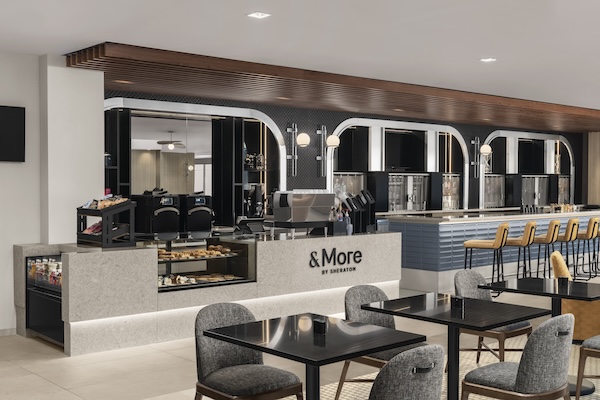
&More by Sheraton at Sheraton Hartford Hotel at Bradley Airport.
On the Money
Jittery markets have had a whipsaw effect on the airline industry with the daily ebb and flow of oil prices caused by turmoil in the Middle East. To no surprise, airline prices are going up on account of it, which makes travelers think twice about purchasing a plane ticket. Domestic airfares are trending roughly 15% higher than last year, according to data. Fluidity makes revenue managing airport hotels that more challenging. “Revenue management can be extremely dynamic because demand can change quickly with travel disruptions,” Schroder said. Beyond geopolitical tensions, a storm in another part of the country or a series of cancellations can suddenly shift inventory and make forecasting more complex. “We focus on constant monitoring—looking at airline activity, weather patterns and group demand—while maintaining close communication between revenue management, operations and sales,” Schroder added.
The same fluidity is a constant test at Hilton Los Angeles Airport—a push and pull between competing forces. “Airport hotel revenue management is uniquely dynamic because demand is driven by both predictable patterns and sudden spikes,” said Ragonese. “You’re balancing contracted airline business, group demand, transient travelers and irregular operations all at once.” Having a cohesive strategy is crucial. “The key is segmentation discipline,” he continued. The hotel layers business segments to maintain base occupancy while preserving flexibility for higher yielding opportunities that might come along ad hoc that are typically tied to citywide events, sports and entertainment demand.
Do airport hotels have a rate ceiling? Some might, especially older properties that call themselves airport hotels are located some distance from the airport. As Ragonese pointed out, historically, airport hotels were perceived to have a price maximum. “Today, that ceiling is evolving,” he said, especially those airport properties that can successfully reposition as more lifestyle-driven and experience-oriented. “When the product and programming justify it, pricing power follows,” Ragonese said.

Sky Pavilion at Hilton BNA Nashville Airport Terminal, which opened in 2024.
CoStar’s Freitag is more analytical. “You want to outpace inflation, right?” he offered, a task more daunting as inflation continues to creep upward. Raising rates effectively is contingent on whether travelers will pay them. According to CoStar data, airport hotels in the U.S. reached an average daily rate of $139.54 in March YTD 2026, $3 higher than over the same period a year ago and an increase of 2.2%. In March 2026, the annual headline inflation rate in the U.S. was 3.3%. It rose to 3.8% in April.
At the same time, YTD March RevPAR at airport hotels was 5.4% higher than at the same period a year ago. In comparison, suburban hotels, the closest comparable asset class to airport hotels, recorded an ADR of $126 in the same period, according to CoStar, with a RevPAR increase of 3.9%.
Airport hotels in no uncertain terms play a specific role within the hotel ecosystem—they may not be the lead, but as a supporting cast member, they are integral. “Airport hotels play as emotional transition spaces,” Ragonese said. “Guests arrive at pivotal moments, before major business meetings, after international journeys, or ahead of milestone vacations. We sit at the intersection between departure and arrival, anticipation and recovery.”
DUHC&S | Strategic Hospitality Consulting & Advisory
We transform hospitality and tourism businesses through strategic solutions, operational efficiency, and comprehensive renovation. With over 40 years of experience working with brands like Hilton, Hyatt, Sheraton, and Sonesta, we enhance asset value and profitability through:
*Operational excellence and brand standards (GSI +90%)
*Market penetration and commercial strategies
*Key partnerships and disruptive innovation
*Hotel openings and repositioning
Proven results :
✅ 48% GOP |
✅ +120% asset valuation growth
✅ Successful projects across 6 Latin American countries
🔹 Let's connect :
📩 Email: diurugeles@gmail.com
📱 WhatsApp: +57 3153259968
Instagram: https://www.instagram.com/diur_2000/
https://viajes-noticias-duhospitality.blogspot.com
https://viajes-duhospitality.blogspot.com
https://travel-duhospitality.blogspot.com
Disclaimer
DUHC&S shares this information for educational and informational purposes only. The news articles reproduced here are sourced from public and recognized media outlets. We are not the original authors of this content but rather distributors of it. All credits go to the original sources cited in each article. If you are the legitimate owner of any material and wish to have it modified or removed, please contact us immediately at diurugeles@gmail.com, and we will address your request promptly.


Comments
Post a Comment