Why hotels currently the favored flavor for APAC investors
Why hotels currently the favored flavor for APAC investors

SINGAPORE — Pan Pacific Hotels Group CEO Peng Sum Choe remembers it wasn’t that long ago that hotels weren’t the favored assets to own in Asia Pacific, especially compared to office building assets. However, the times and investment flavors have changed.
“Hotels seem to be the flavor of the month or the flavor of the year [right now]. The yields are going up,” Choe said on stage at the opening of HICAP 2025 in Singapore. “One thing I’d say to a lot of hotel investors is if you have to have a very good location in a city center and obviously you’ll pay a high price. The operating yield will not be that sexy, but it’s a long-term asset. Most of the time, if we look at the total return… it makes sense.”
Although Singapore-based Pan Pacific considers most of the hotels it owns to be long-term assets, that doesn't mean the company won’t sell. He mentioned Pan Pacific's 2024 sale of the Park Royal Kitchener in Singapore, which featured an eye-popping return.
“Last year… we sold a hotel at S$530 million and on our books it was S$100 million. That’s almost a S$430 million profit. What other place can you get that?” Cho said.
Choe was part of the “Views from the Boardroom – Round One” panel on the first day of the 35th annual Hotel Investment Conference Asia Pacific (HICAP). The panel included Jihong He, chief strategy officer of Shanghai-based H World Group and executive chair for H World International; Yoshiki Kaneda, president and representative director for Tokyo-based Seibu Prince Hotels Worldwide; Bob van den Oord, CEO for Hong Kong-based Langham Hospitality Group; and Alex Murray, vice president and regional head of Southeast Asia for Hilton. Jennifer Davey, director, Australia for Horwath HTL, served as moderator.
Because H World International has such an extraordinary amount of hotels (Jihong He said the company runs about 12,000 hotels and about 1.1 million rooms, with most of them franchised), it’s an essential paradigm for the company to have its franchises be able to make a good return so it can keep up with massive growth.
“We open about 2,300 hotels a year… That means that all our franchisees need to see [returns]. Otherwise, we’ll have difficulty signing new deals,” she said. “In order to make a return for them, we really look at every aspect of the business.”
Jihong He said the model also must include the ability to renovate hotels at a lower cost.
“We build a very big supply chain and find the products… So they can exactly calculate how much they will have to spend on the renovations,” she said. “For each category of hotels, each brand will have a very clear target cost and we cannot exceed that.”
That also means each H World hotel franchisee has a clear understanding of what the GOP will be for hotels.
“We run mostly limited-service hotels. So, our GOP margin is between 50, 60, 70%,” Jihong He said. “We have to promise our franchisees that GOP margin. Otherwise, they will say, ‘How long is my investment return?’”
What owners value
Oord said it takes an owner to understand an owner. So, Langham and its parent company, Hong Kong-based Great Eagle Holdings Ltd., are able to cater to what a potential investor is looking for.
“It’s not particularly rocket science. An owner is looking for someone who can take good care of their assets and who can give good financial returns,” he said. “Of course, as an operator, we want brand strength. We want integrity. Ultimately, these two parties will have to work closely together to achieve success.
“Throughout that partnership, it’s going to be really important to have transparency and to be able to have frank discussions when you might get off [the path] at times.”
Murray said that for Hilton, it’s about working with their owners to ensure they have the right partner and deploy the right brands in the right applications at the right time.
“It’s important to ensure the integrity of your brands, because essentially, they’re the ones that help you deliver those premium returns,” she said. “At the same time, there really has to be a deep understanding of the investment intent, the horizon that the owner aspires to and how long the asset will be kept as well, and make sure that you really deepen that understanding of what is going to make that partnership a success for both the operator and the brands, as well as the owner and the investor.”
Murray said it’s those positive experiences for owners that allow Hilton to continue growing in places like Asia Pacific.
“In my experience, it’s good examples where we are securing a lot of repeat hotel deals with existing owners because there’s trust there,” he said. “There’s an understanding that if you get this mutual understanding right, you really act in the spirit of doing the right thing for the owner and for the investment and that translates into that trust to grow together and making sure that the investors are successful for the long term.”
For Seibu Prince, which recently made a splash with its acquisition of Ace Hotels, Kaneda said the company’s basic strategy is to determine when it should be asset-light with an HMA, and when the company should take an ownership stake.
“The decision between being an owner/operator or an HMA will be delivered by mainly two considerations: location and brand,” he said. “In terms of location, we will consider ownership in key, strategically important cities in Asia Pacific… In secondary cities, we prefer management contracts. We will consider key money to secure a deal. If the right opportunity comes along.”
Kaneda said lifestyle hotels are also candidates for ownership. “Lifestyle hotels require more details… [for] the asset and more control over the asset by the operator,” he said.
US construction lowest in 40 Quarters

https://www.hotelinvestmenttoday.com/Development/Owners/US-construction-lowest-in-40quarters
By Jeffrey Weinstein
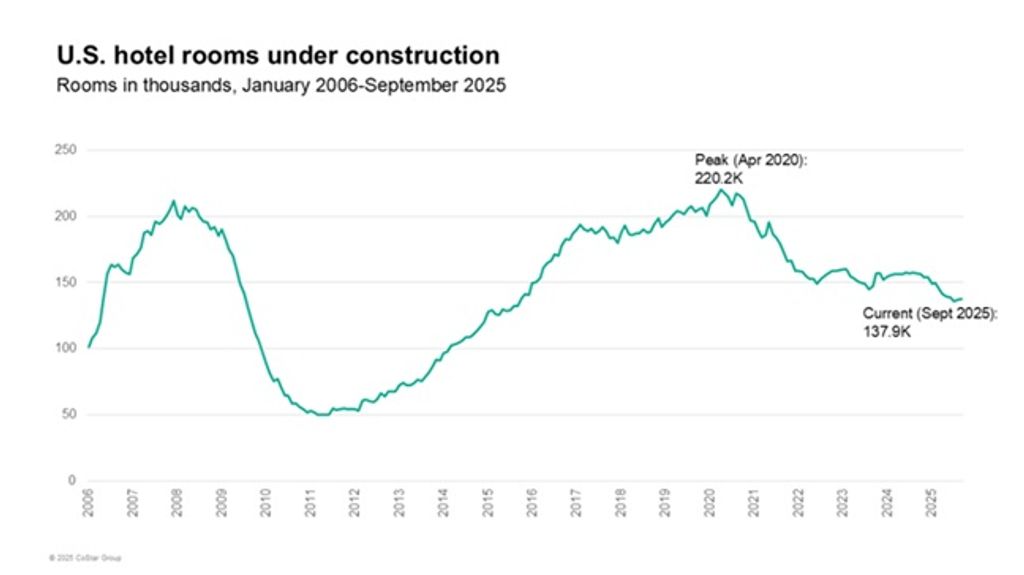
Without favorable dynamics, inaction remains the constant among developers when looking at CoStar’s September data.NATIONAL REPORT – The volume of U.S. hotel rooms under construction decreased year over year for a ninth consecutive month, according to September data from CoStar.
Hotels in construction stood at 137,956 rooms (-12.3% YOY); in final planning was 258,836 rooms (-3.5% YOY); and in planning stage at the end of September was 327,304 rooms (-2.6% YOY).
“More than 80,000 rooms below the peak from Q3 2020, construction fell to the lowest point of the past 40 quarters,” said Isaac Collazo, STR’s senior director of analytics. “Uncertainty often leads to inaction, and developers and financial institutions are still waiting for a more favorable environment. Higher building and material costs are also hampering groundbreakings, and we don’t foresee the cycle turning for some time. However, more rooms are under construction now than after the Great Recession—development is down but still happening.”
Chain scale segments (% of existing supply, in-construction room count) for September 2025 (percentage change from September 2024):
1. Luxury (3.8% / 5,911 rooms)
2. Upper Upscale (2.1% / 15,292 rooms)
3. Upscale (3.6% / 33,376 rooms)
4. Upper Midscale (3.3% / 39,075 rooms)
5. Midscale (2.4% / 12,746 rooms)
6. Economy (0.7% / 4,559 rooms)
Extended-stay segment’s investment opportunities attract affirmative attention

NATIONAL REPORT — The extended-stay segment’s long-term resiliency, especially during difficult and unpredictable economic times, is a key consideration for investing in the product type, according to Hotel Investment Today by Northstar’s 2025 Extended Stay Measurement Report completed in July 2025.
This first-party measurement study, commissioned by Extended Stay America, included questions aimed at gaining an overall sense of where the extended-stay segment stands in the eyes of the hotel investment community.
Hotel Investment Today’s audience of hotel owners, investors, developers, and operators shared their sentiments about how the sector is influencing their real-world, real-time pipeline and portfolio decisions.
TRENDS AND TAKEAWAYS
The future looks bright. One of the key findings in the survey was respondents’ near-consensus on the segment’s positive development outlook. Results revealed that 98.4% of participants perceived the future of extended-stay development in a positive light. More than two-thirds of respondents described the development outlook as bright, citing proven sector resilience across cycles, demand diversity, and operating margins among the primary drivers. Over 33% forecasted a “moderate” pace going forward. Increasing construction costs are the major hurdle to growth, according to respondents.
Extended stay is a strong investment vehicle. The vast majority of respondents expressed confidence in this investment type. The data reported that 87.4% of participants viewed the sector as a solid investment option. Nearly two-thirds of respondents rated extended stay a “4” or “5” on a 5-point scale of investment potential. Over 25% termed it “full of potential.” And 85% of respondents said they are interested in pursuing extended-stay opportunities.
However, a more telling measure of investor confidence in today’s market was the limited skepticism among participants. The middle ground — those who view extended-stay as "attractive yet tough" — represented over one-fifth of respondents (21.7%), indicating that most investors have formed more definitive opinions about the segment's prospects. Only 13% of respondents rated extended-stay investments as "not of interest," while 2.9% gave it a “2” rating, suggesting that even cautious investors see merit in the extended-stay model.
Segment exposure is pivotal to portfolio diversification. In fact, an overwhelming 98.3% of participants attached some level of importance to the role of extended-stay hotels in building a balanced portfolio. Survey data showed that 62.1% of respondents rated extended-stay hotels as “important” or “extremely important” to achieving portfolio diversification (see Fig. 1). This has opened new opportunities to capitalize on this segment based on its strategic value in investment planning. As expected, sentiment on the optimal mix of extended stay and transient hotels covered a wide range. The majority of respondents reported that extended stay comprised 10% to 50% of their existing portfolios.
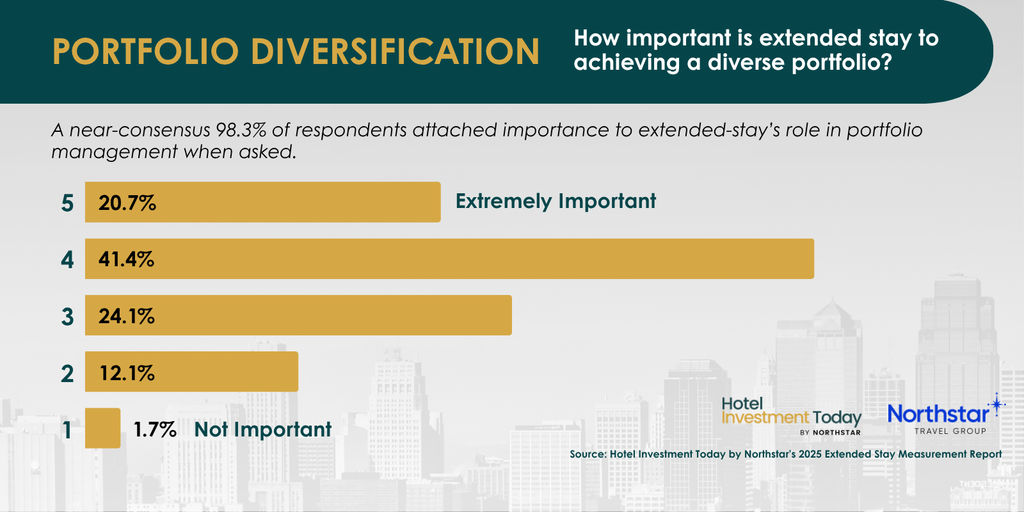
"The near-unanimous optimism we're seeing — with over 98% of respondents viewing extended stay's future positively — reflects what we've observed across the industry: this segment has proven its resilience and continues to deliver strong returns even in challenging economic conditions,” said Mark Williams, Managing Director of Franchise Development, Extended Stay America.
Investors identified strengths, challenges that most influence their development decisions. When asked to check “all that apply” as reasons for investing in extended stay, participants listed “consumer demand trends” (68.3%), “strong operating margins” (66.7%), “cross-cycle resilience” (58.3%), and “length of stay” (50%) at the top of the rankings. (See Fig. 2). “Construction cost efficiency” (35%), “access to financing” (31.7%), and “brand affiliation opportunities” (31.7%) represented other contributing factors to investor interest. However, the respondents voiced areas of concern. Key among them were overdevelopment, rising costs, and regional saturation, suggesting the need for deeper market-by-market diligence to maximize returns.

Extended-stay properties offer several advantages that increase their appeal to investors relative to traditional hotel models. As reflected in Fig. 3, results pointed to a relatively even split of extended stay’s various advantages over transient hotels. Extended stay’s “efficient operating model” and “profitability” topped the list of strengths at 28.3% and 26.7% of responses, respectively. Participants also highlighted operational and performance benefits stemming from factors unique to the segment. That included a “predictable revenue stream” (18.3%), “fewer daily check-ins/check-outs” (13.3%), and “labor (11.7%).
“What's driving investor interest isn't only one factor — it's the combination of operational efficiency, predictable revenue, and strong margins that you simply don't find in traditional select-service models,” said Williams. “Extended stay hotels can deliver on multiple fronts simultaneously."
New-builds dominate present and future pipelines. Data showed 83.4% of respondents are actively considering extended stay assets for new construction. According to the survey, 23% have ground-up projects underway, and over one-third favored new construction for future expansion. Nearly 63% of those surveyed are considering development of “one to two” new construction projects in the sector. Another 16.7% said they are exploring “three to five” new-build extended-stay assets, and 4.2% have plans for “six to 10” new extended-stay openings.
Nearly three-quarters of new projects will break ground within two years. New construction timelines for active projects showed that 74.9% of participants anticipate breaking ground within two years. Detailed metrics indicated 20.8% are on a fast track with scheduled starts within “six to 12 months.” More than one-third of respondents (33.3%) plan to start their projects within the next “12 to 24 months.”
Interest in conversions is beginning to accelerate. Survey metrics revealed that 20% of participants have conversion projects in their current pipelines.

Results indicated investor sentiment toward conversion versus new construction could see a major shift.
When asked about which types of extended-stay projects they would be more likely to pursue beyond their current pipeline, 36.7% of respondents ranked “ground-up new-builds” as their top choice. Although this confirmed continued interest in new development, the statistics predicted a significant change regarding sentiment on conversion.
The results showed 51.7% of participants would consider conversion as their pipeline driver. Of that total, 21.7% would be open to converting transient hotels to extended stay. Close to 17% would explore reflagging an existing extended-stay hotel, while 13.3% expressed interest in converting a non-hotel asset, such as office or residential, and 11.7% had no strong preference.
Typical conversion timelines target completion in under two years. The survey data confirmed similar time frames for new construction and conversions. Among readers considering conversions, 41.7% had “12-to-24-month” completion timelines. Much like investors who have new construction projects underway, an estimated 17% of respondents planned to finish conversions within “six to 12 months.” A similar percentage have conversions that will debut within six months. One-quarter of participants had no conversions planned.
"With new projects breaking ground within two years and conversion activity accelerating, we're witnessing a transformational period for extended stay hotels,” said Williams. “The investors moving now are positioning themselves to maximize returns as the extended-stay market continues to grow.”
Mary Scoviak is custom and design content director for Hotel Investment Today by Northstar.
DUHC&S | Strategic Hospitality Consulting & Advisory
We transform hospitality and tourism businesses through strategic solutions, operational efficiency, and comprehensive renovation . With over 40 years of experience working with brands like Hilton, Hyatt, Sheraton, and Sonesta , we enhance asset value and profitability through:
Operational excellence and brand standards (GSI +90%)
Market penetration and commercial strategies
Hotel openings and repositioning
✅ +200% asset valuation growth
✅ Successful projects across 6 Latin American countries
#DUHC&S #HospitalityConsulting #OperationalExcellence #Hotels #BusinessTransformation
Disclaimer


Comments
Post a Comment